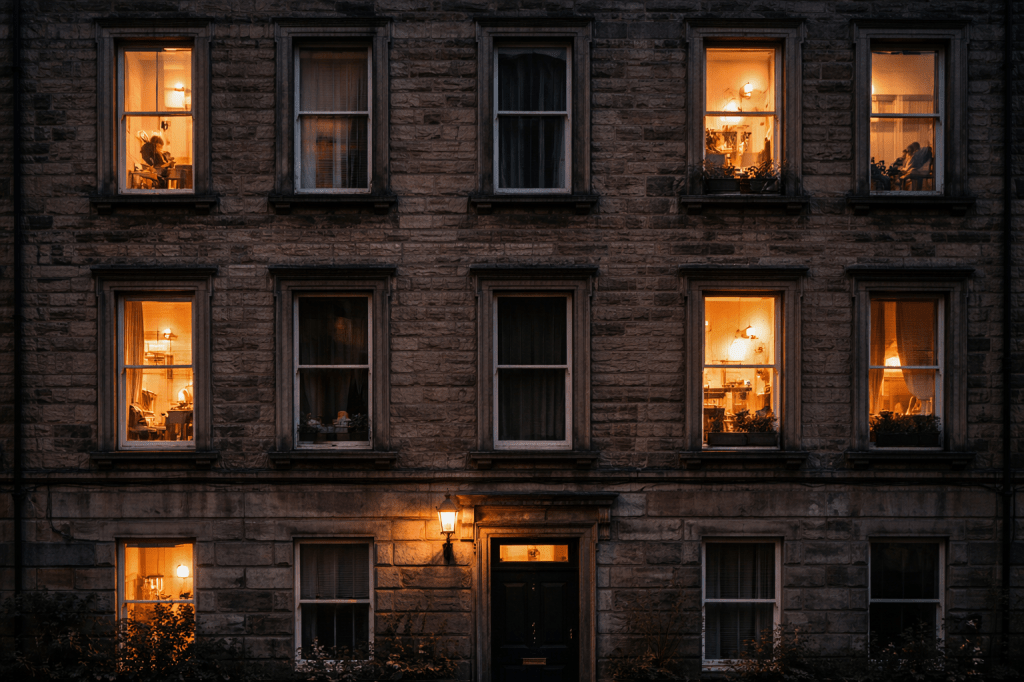
She walks because stopping would give the city time to catch up with her thoughts and she has learned that thought is a kind of weather that turns suddenly and without warning, and so she keeps moving through streets that narrow and widen like lungs learning a difficult breath, past tenement fronts where windows glow in uneven rectangles and the lives behind them arrange themselves into small illuminated theatres of almost-belonging, and she looks up not because she expects to be seen but because the light has weight tonight, because it falls onto the pavement in soft squares she steps through as if each one were a room she might enter if the rules of glass and gravity were kinder.
Behind one window a woman bends over a sink and the steam from boiling water blurs her face into a smear of motion and care, and behind another a man leans over a table covered in papers and mugs and the slow archaeology of days that stack themselves into domestic sediment, and higher up a child moves through a room carrying a blanket like a flag of sleep, and she watches these fragments not as stories but as textures, the way warmth seems to cling to glass and the way curtains make borders that can be crossed only by light, and she feels the soft envy rise in her like a tide that does not know where to break, the tender ache of imagining herself inside those lit frames where chairs wait for bodies and names are said without echo and the future is allowed to be small and repeatable, and she tells herself that windows lie, that every rectangle of light hides its own darkness, that behind each careful arrangement of lamps and plants there are arguments folded into drawers and silences arranged neatly between cups, and yet the sight of them still tugs at her ribs with a quiet insistence, the suggestion that there is a version of life that fits inside rooms, that can be contained by walls and scheduled into evenings, and she walks past them with her hands in her pockets, carrying the strange double weight of wanting and not wanting, of imagining herself sitting at those tables and at the same time already rehearsing the leaving, the moment when she would stand up from the borrowed warmth and step back into the street where the air does not remember you, and sometimes a shadow moves behind the glass and for a breath she feels almost present there, as if her reflection in the window might slip through and take her place in that soft-lit interior, as if she could become a small figure among plants and shelves and the ordinary debris of living, and she lets herself linger in that illusion for the length of a traffic light changing colour, for the brief second when the city holds still and the world seems arranged into frames that could be stepped into, and then the moment breaks and the lights change and the windows become only windows again, and she keeps walking, carrying with her the gentle cruelty of glimpsed domesticities, the knowledge that some warmth is visible only from the outside, and that the glass between her and those lives is thin enough to look through and thick enough to keep her moving on.
 Hallway After Midnight