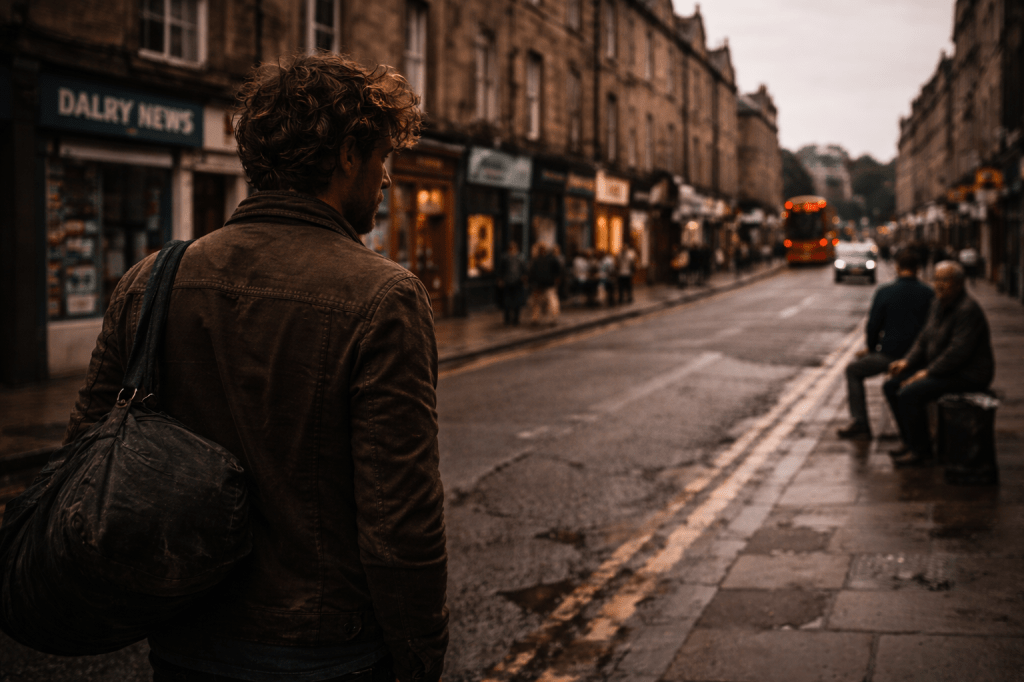
I walk Dalry Road the way you walk a tune you half-remember, footfall syncopated, step-step-hold, the street coming at me in bars and breaks, bus-hiss, shopclatter, stone still holding the night in its pores, and I’m listening harder than I should because this is where he used to be, Jamie-place, Jamie-angle, Jamie-lean, and the habit of looking for him hasn’t worn off yet, not quite, not even now.
Here—by the rail. No. There—by the shelter. Still no. He never arrived dramatically, Jamie didn’t, no ghost-theatre, no boo, just there suddenly, already mid-thought, already leaning like the city had grown him that way, cigarette paused, eyes doing that sideways measuring thing, weighing me, weighing the street, deciding which lie was worth puncturing today, and he’d speak after a delay, always, like the sentence had to walk a lap before it earned its ending.
I stop, I wait, I listen, yet there’s nothing but the city clearing its throat, and a bus exhales, and a woman laughs into her phone like she’s trying to convince it, and a man with bread passes, bread-tender, bread-serious, and the street keeps time—tap-hiss-shhh—like it hasn’t noticed anything missing, and my eyes keep snagging on shapes that almost fit: coat-right-wrong-shoulders, voice-right-wrong-mouth, shadow-holds-for-a-second-then-slips, and every almost clangs a little inside the chest.
Jamie used to stand here, or maybe there, or maybe the standing was never the point, and I realise how long it’s been since I last saw him proper, not memory-seeing, not story-seeing, but flesh-and-coat-and-breath seeing, and the gap opens underfoot, just that dull architectural sadness, the kind that rearranges load-bearing beams quietly while you’re not looking, and I can’t remember him leaving a note, because people like Jamie leave methods, they leave ways of seeing that keep working long after the operator’s gone.
I walk, stop, walk again, past the pub with its old-argument smell, malt-ghost, afternoon-stain, past the corner where he once told me—sideways, indirect, Jamie-style—that staying badly is just another kind of leaving, and I didn’t like it then, didn’t thank him for it, because advice is always an insult when it arrives before you’re ready, but now the sentence pings back, late but accurate, and I wince at my own timing, and I think about asking him something, anything, everything.
What do you do when motion stops feeling like choice. How do you tell drift from freedom when they wear the same boots. How long can you keep walking before it becomes a refusal instead of a gift, and the questions line up nicely, but no one answers, the street doesn’t even echo them back, and that’s when it lands with a soft administrative thud, like a file being closed without ceremony: He’s not coming. Not today. Not later. Not in any version of this street I still have access to.
And I sit on the low wall where we once watched nothing happen for nearly an hour and called it education, the stone cold through denim, the city sliding past, and I feel the last hope unhook itself quietly, a letting-go that feels almost professional, because whatever Jamie had to say, he’s already said it, whatever I was meant to hear, I heard wrong or late, like I always do.
And I stand, and the wall keeps my shape for half a breath, then releases it, and Dalry Road carries on—generous-indifferent, making space without mourning, offering new ghosts to anyone careless enough to mistake them for guidance, and I step back into the flow, lighter-heavier, tuned slightly off from before, knowing this wasn’t a search so much as a confirmation, a frequency check that came back clean and empty.
And it’s true, you don’t return to ask the dead what’s next, you return to hear the silence clearly enough to stop asking, and when I leave the street this time, I don’t scan for him, don’t angle my head for the lean that isn’t there, and I let the absence walk beside me instead, keeping time, tap-step-shhh, a quiet companion that doesn’t pretend to know where we’re going but doesn’t ask to be left behind either.

 Hallway After Midnight