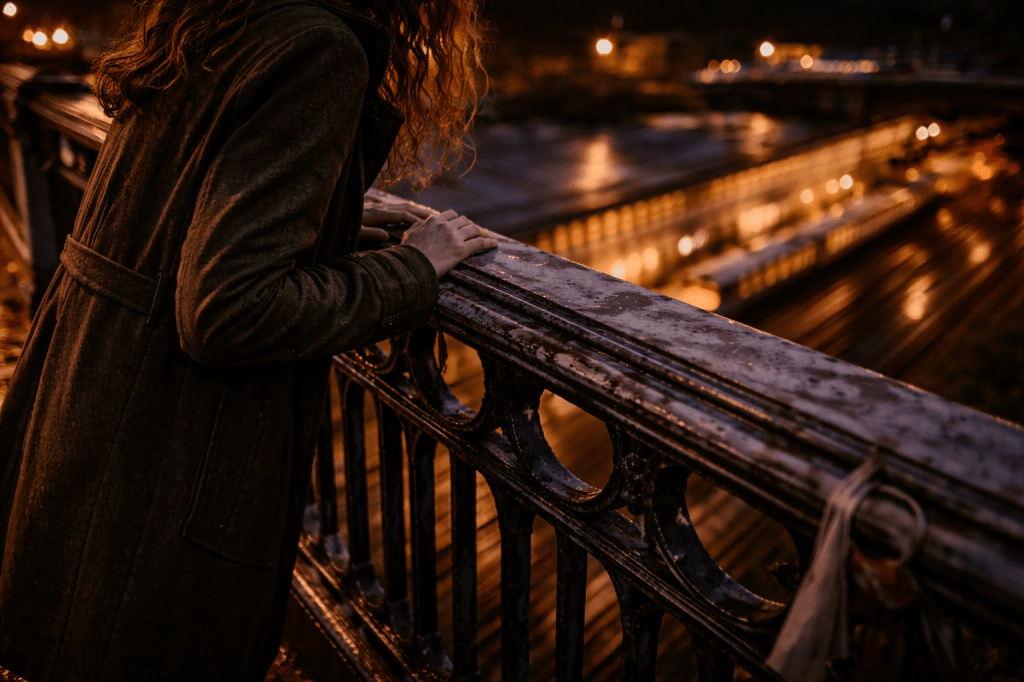
After a long while of standing there with her hands resting against the iron railings and the wind threading quietly through the bars—hushhush railhush—and the low murmur of the station rising from the hollow beneath the bridge, Mara becomes aware again of the simple fact of her own body, not as an idea and not as a memory but as a physical presence occupying space on the narrow pavement between the street and the drop.
The awareness begins in small places, in the slow pressure of her boots against the damp stone beneath her feet and the faint ache in the muscles of her calves from the long walk uphill through the city, and the weight of her coat settling unevenly across her shoulders where the fabric has absorbed the evening’s rain, and the cool metal of the railing pressing lightly against the inside of her palms as she leans forward just enough to feel the support of it, and gravity does its quiet work, every structure on the bridge is arranged around that invisible downward pull—the railings rising from the pavement, the lamps anchored firmly in their iron bases, the thick stone pillars holding the long span above the station—and the body obeys the same patient law, feet resting on pavement, bones bearing weight, muscles adjusting themselves constantly in tiny unseen corrections to remain upright against the slow persistent tug of the earth.
The thought comes to her without drama, that falling would simply be another expression of the same force, less a violent act of rebellion against the world, more a brief surrender to the rule that governs everything already—the trains gliding along their rails below, the rain sliding down the metal bars beside her hands, the slow settling of dust and leaves and forgotten scraps of paper along the edges of the pavement, and she tests it almost unconsciously, leaning forward slightly against the railing and feeling the distribution of weight shift through her body—bootheel pressure anklebalance hiptilt—and the railings hold steady beneath her hands with the quiet reliability of something built precisely for this moment of resistance.
And the wind moves around her again, lifting the loose strands of her hair and brushing softly along the fabric of her coat while the bridge continues its low conversation with the city—roadhiss farbelow trainhum metalcreak—and the sounds remind her that the entire structure exists only to hold weight safely above the open space, and the strange thought arrives that the bridge itself is a kind of answer, a long iron sentence written across the air declaring that even here above the hollow of the city there must be something solid beneath a person’s feet, and that the span between two points can be crossed slowly and deliberately without surrendering to the pull waiting below.
She stands there feeling the quiet gravity of her own body pressing into the pavement and the railings cool beneath her hands while the trains move steadily through the station beneath the bridge and the wind continues its patient whisper—hushhush hush—across the iron bars.
 Hallway After Midnight