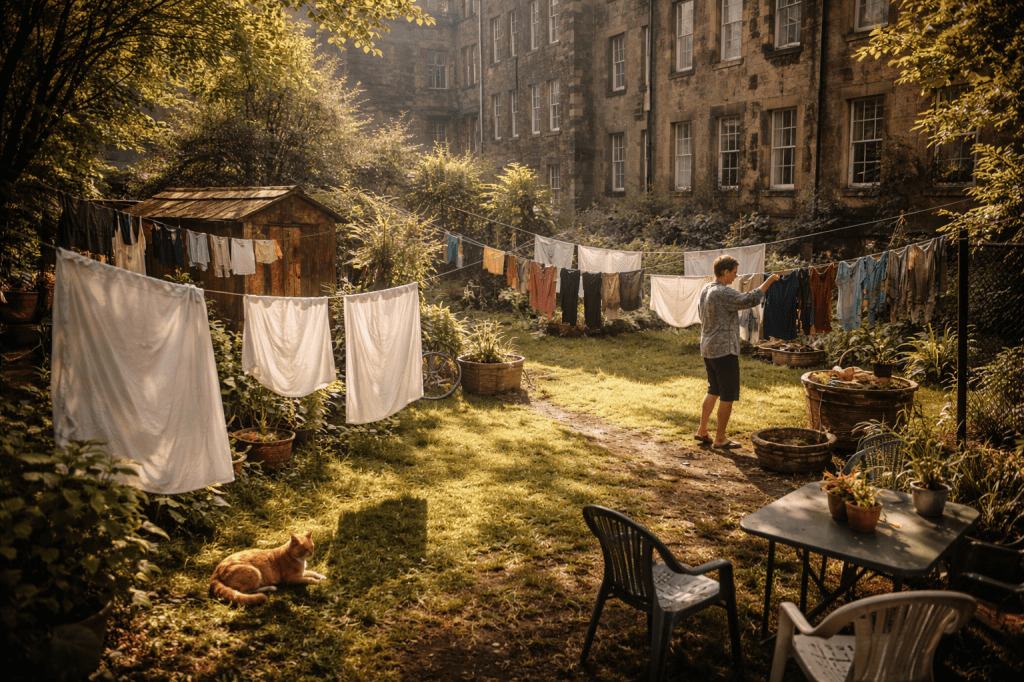
Late morning light spilled into the back green like it had nowhere else to be, lounging lazy across the grass-patch that never truly dried, that soft sodden rectangle squeezed between three tenements and a rusted shed full o’ nobody’s tools and everybody’s spiders, and I leaned out my window half-dressed with a mug of something hot-enough-to-feel-real, looking down at the small parade of lives already in motion, those quiet backgreen saints stringing their days along the washing lines, each peg-click a tiny gospel of getting on with it, and the wind—still cheeky but not the teeth-baring savage it becomes after five—flicked through the sheets with a shy flutter like a kid testing its courage, and the whole place pulsed with that homegrown daytime rhythm that never makes the postcards: damp socks, steam from backdoor kettles, arguments drifting out of half-open windows about bins and borrowed tools and “whit happened tae the good towels?”
Mrs. K from the ground floor was out first, and her dressing gown had the colour of old heather, hanging great white fitted sheets like surrender flags, muttering to herself in a low rolling growl that could have been prayer or complaint or both because in this city they’re often the same, and I watched the sunlight catch the cloth, bright as new teeth, saw it billow like a ship’s sail wanting adventure but getting laundry instead, and it made me think—aye, stupidly, sentimentally—about how the ordinary things hold the world together far better than the great dramatic ones, how a clean sheet can feel like forgiveness if you’re tired enough.
Then came the lad from flat 3F, a student or a poet or a long-suffering barista—hard to tell at a distance—who clattered down the back stairs in slippers, and who carried a basket of clothes that looked like it hadn’t seen a wash since the referendum, and he hummed something tuneless as he worked, throwing t-shirts across the line with the precision of a man who’ve decided perfection’s for other eras, and as he pegged up a pair of boxers with pride or resignation I couldn’t tell, a pigeon landed near him, fat and unbothered, cooing its wee rhythmic nonsense like the city’s own metronome beating time for all of us too slow or too sad or too stubborn to keep our own tempo.
The sun slanted down further, lazy as a dropped curtain, and the whole back green went soft-focus, and the edges blurred into that half-remembered dreamlight you get on days where nothing’s happening and everything’s happening because life’s in the small motions, the small mutters, the way a neighbour sighs while lifting a damp towel, the flick of a wrist shaking out a jumper like beating dust from the heart, the brief bright laugh from someone unseen spilling down from a window above like a wee gift the city forgot to charge for.
A cat—ginger, moth-eaten, clearly some local kingpin—strode across the path, sniffed the air, eyed the laundry with judgement, then plopped itself under the shadow of a sagging duvet like it had reserved the spot in advance, while two more neighbours emerged from somewhere, bickering cheerily about whether the sky looked “too blue to trust,” that classic auld reekie superstition that sunlight is a practical joke and rain is the punchline, and I listened as they weighed the risks of hanging delicates in a city where the weather’s run by a committee of schizophrenic gods.
Someone upstairs opened a window with that heavy tenement groan, and the sudden clatter of cutlery hit a sink burst out as soundtrack to the gentle streetnoise drifting in—kids yelling, a dog yapping, a bus sighing its hydraulics far off—and for a moment I felt something inside me ease, some knot unfurling, the mind’s dimstate finally giving way to the day-shift chorus of living people living their living lives: sheets breathing, pegs clicking, mugs steaming, sun warming the worn-out corners of our yards and our bones alike.
And the back green, in all its unremarkable glory—weed-fringe, cracked concrete, mismatched lines sagging like tired smiles—felt like a kind of tender truth, an unpretentious room of the city where the ghosts stayed quiet and the shadows had the decency to wait until evening, a place where even the broken things looked content to rest a while, where new stories didn’t need thunder or neon or night to start, where sunlight touched everything like it was old friends with the world.
The wind picked up, just a wee flirt, and the sheets rose in a slow wave, brushing against each other like strangers sharing a soft secret, and I realized I’d been watching for nearly an hour without meaning to, my mug now cold in my hand, my thoughts brightened by ordinary motion, the tenement lullaby tuned to daytime softness instead of night’s restless hum.
And for just that minute, with the sun slung low, with the laundry dancing its quiet dance, with the city not demanding anything from me—I felt something like peace, untidy and sunny and sincere, fluttering on a washing line made of other people’s lives.

 Hallway After Midnight