She moves because standing still has begun to feel like sinking, and the bypass sings its endless carriver rushrushrush behind her, a long artery of light-smear and engine-breath and rain-polished asphalt, and the grass by the verge is flattened into tired green sleepmats by last night’s boots and last night’s bodies and last night’s not-quite-names, and the cold air scrapes the back of her throat with that metallic tang of exhaust and wet iron and winter-breath, and her jacket smells of old smoke and borrowed rooms and the faint citrus of someone else’s soap that never quite leaves, and she walks because the body knows routes even when the mind is a scatter of broken glass-thoughts, and her boots find the cracked pavement-rhythm, thud and slip and thud, and the underpass mouth yawns ahead like a concrete throat swallowing sound, swallowing light, swallowing the small leftover parts of night that have not yet learned how to become morning.
And inside it the echo multiplies her into a thousand versions of herself, footstep herstep ghoststep, and the walls sweat old rain and old graffiti prayers, half-words and heart-scratches and the blurred theology of teenagers who once believed that writing a name could keep a thing alive, and the fluorescent strips flicker-fizz like insects trapped in glass, and the smell shifts to damp, to pissghost, to that hollow underground scent that belongs to places where nobody stays but everybody passes, and she passes too, shoulder brushing cold tile, breath puffing white then vanishing, and her reflection swims in puddle-mirrors on the floor, face bent, hair bleeding red into the water like a wound that won’t decide if it’s healing or still opening, and she thinks of how every reflection lies a little, how every surface takes something and gives something else back.
She thinks of the word passage and how it sounds like a promise, and how promises always carry their own small betrayal in the syllables, and the memoryflickers start, unwanted but faithful, the flatroom ceilings, the wallpaper peeling like old skin, the voices through thin walls that never quite belonged to her but always seemed to speak about her, and the way silence can feel like a held breath about to become a scream, and she presses her hands into her pockets and feels the lint, the ticketstub-soft edge of yesterday, the coin she never spends because it was given with a look that said stay, and she didn’t, and the body keeps score in these small tactile reliquaries, keeps the past folded into fabric and skin and the tight ache behind the ribs.
And the subway mouth opens beyond the underpass like a wound that leads downward instead of in, and the stairs are wet and darkened by countless soles, each step a small history of weight and leaving, and the smell becomes warmer, oil and electricity and human closeness, and the sound thickens, becomes a layered breathing of machines and announcements and footsteps overlapping, and she lets herself be carried into the pulse of it, the city’s bloodstream humming under its own skin, and the ticket gate clicks her through with a brief mechanical forgiveness, a metallic nod that says you may pass, you may become one more anonymous unit of movement, and the platform stretches out in grey and yellow lines, a long low corridor of waiting faces and waiting eyes and waiting silences stitched together by timetable-light.
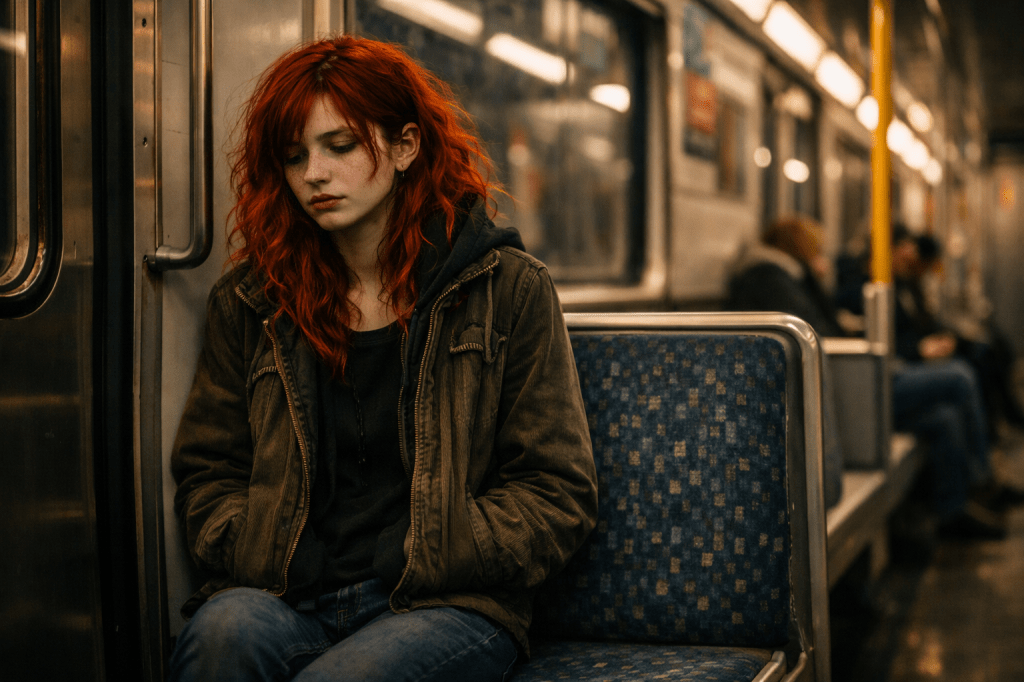
And she stands among them, not quite among them, haloed by the red of her hair and the quiet static of her thoughts, watching a child tug at a parent’s sleeve, watching an old man count the seconds with his breath, watching a woman mouth words into a phone that is not ringing anymore, and she wonders briefly how many of these strangers are carrying a version of the same heaviness, how many have rehearsed disappearings in their heads like private stageplays, and the trainwind rushes up the tunnel before the train itself arrives, announcing the future by its breath, and the platform trembles into a low animal hum, and she closes her eyes for half a second, not to pray but to listen to the inner noise settle into something like rhythm, a temporary truce between the wanting and the wanting-to-end, and when the doors open she steps inside, into the moving metal lung of the city, and the outside begins to slide away in blurred window-frames, and the stations pass like punctuation marks in a sentence she does not yet know how to read, and the day edges closer, a pale thought at the rim of the dark, and she lets herself be carried, carried, carried, not knowing yet to where, only knowing that stillness has become impossible, and that movement, even borrowed movement, is a way of not vanishing yet.

