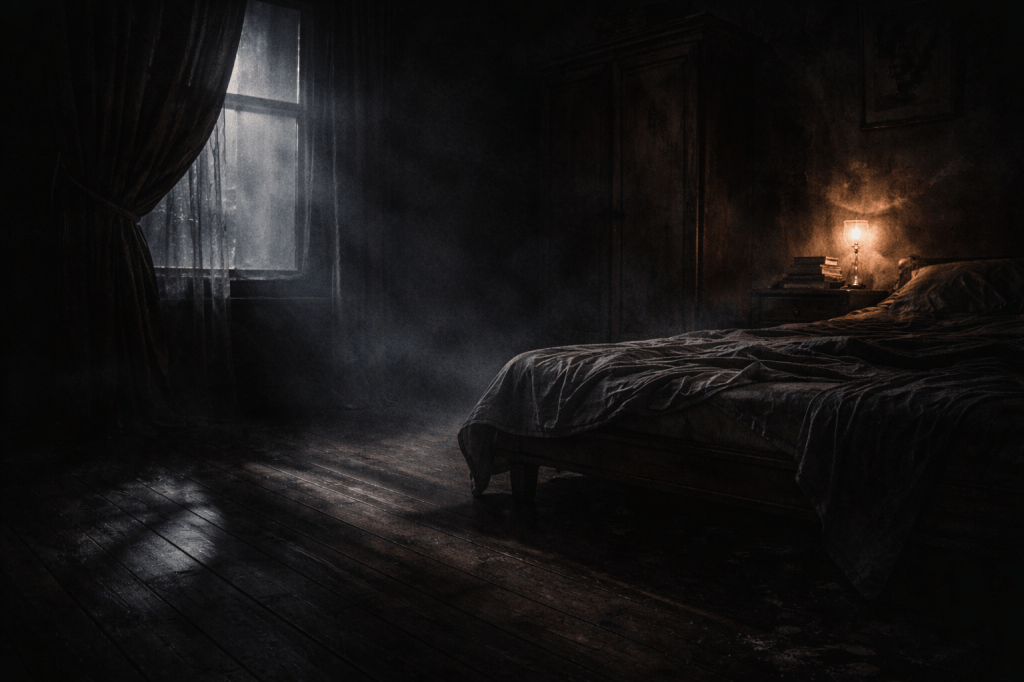
When I was small enough for the world to loom big and wrong-shaped around me, some soft-voiced grownup—mum or gran or maybe just the shadows wearin’ their voices—told me a night-tale to make me sleep, a tale not meant to frighten but meant to hush me, though fright and hush are cousins in a child’s skull, and the story slid in like a cold draft under the door, telling me of the Nocturne Man, aye that whisperthin creature who lived—so they said—under the floorboards or behind the wardrobe or maybe curled up in the dark fold between the wall and the window, waiting for the moment a boy lies still enough for dreaming, and he’d creep out, no louder than breath on glass, and check the room for forgotten fears, collecting them like pennies, shining them with long soft fingers—aye lad, dinnae fret, he’s only takin’ the ones ye’ve already dropped.
And the tale ran on in that drowsy spoon-fed rhythm adults use when the night’s too long and the child’s too awake, and it said the Nocturne Man couldn’t touch ye if ye kept one foot over the edge of the mattress, toes dangling like bait or warning, I never understood which, and the idea was meant to soothe me—look lad, he’ll see yer foot and ken you’re brave enough for dreamland—but instead it twisted the whole room into a shiverbox where every creak and sigh in the plaster spoke in its own cracked wee voices, where the wardrobe hinge wheezed aye lad I see ye, where the radiator pipes mumbled he’s comin’ he’s comin’ hush now, where the floorboards stretched in the swell-night heat, groaning the groan of something settling or something waking or something hungry or something merely tired of bein’ walked on all day.
I lay there stiff as cold porridge, clutching the blanket like it was a lifeline, and the dark grew thick, aye, that syrupy child-dark that glues time to the walls, and I’d hear the street outside breathing its own stonebreath, while cars hush past like ghosts practising their exits, and foxes yowled in that cracked opera of theirs, and every sound made the Nocturne Man feel nearer, closer, like he was standing in the very corner where the moonlight didn’t reach, swaying slow, patient as old rope.
Sometimes I’d whisper to myself, nonsense-sounds, lulloolull, half-sense hums, just to keep the silence cracked open enough to reassure me that the world still held noise, still held me; sometimes I’d stick a hand out into the cold air, daring him, beggin’ him, testing him—I dinnae know which—and feel the thrillflood rush through my chest when nothing touched it, nothing brushed past, nothing whispered except the blood in my own ears making soft tide noises against the drumskin of fear.
My gran once said the Nocturne Man walked on “memory feet,” whatever that meant, and that he’d leave no fingerprints except on the part of your mind that keeps time slow, and I didn’t understand it then but later, much later, I wondered if she meant that childhood fears are the ones that hang on longest, clingy wee barnacles of dread hitching rides on every adult night when the world goes quiet enough to unmask itself.
And there were nights—aye, I swear it—that I heard a small shift under the bed, a slide of
imaginationsand, a hush-hush breath like a soft old concertina wheezing in the dark, and the air would tilt strange, off-kilter, like a dream had entered the room before I had the chance to fall asleep, and I’d squeeze my eyes shut so tight the dark burst into coloured sparks behind the lids, tiny starbabbles flickering like shy fireflies, and I’d mutter in a cracked whisper dinnae come, dinnae come, I’m good, I’m good, and the room would soften, sag, settle, until the shadows stopped stretching and the floor stopped speaking and the tale’s teeth lost their sharp.
But even now, grown into all my ragged edges, walking the wet city at ungodly hours, I sometimes feel him—that old bedtime phantom—slipping through the fogfolds of my thoughts, checking the corners of whatever room I try to rest in, leaning close with his soft neverborn voice, murmuring in the cracks between breaths—aye lad, I’m no’ here to harm, only to mind the fears ye’ve dropped along the way. And it should comfort me, maybe, but it doesn’t, not quite—and it frightens me a little, but not fully— and it settles in me like all things that come from childhood: a strange warm-cold knot of truth and untruth, love and dread, dark and dream.

 Hallway After Midnight