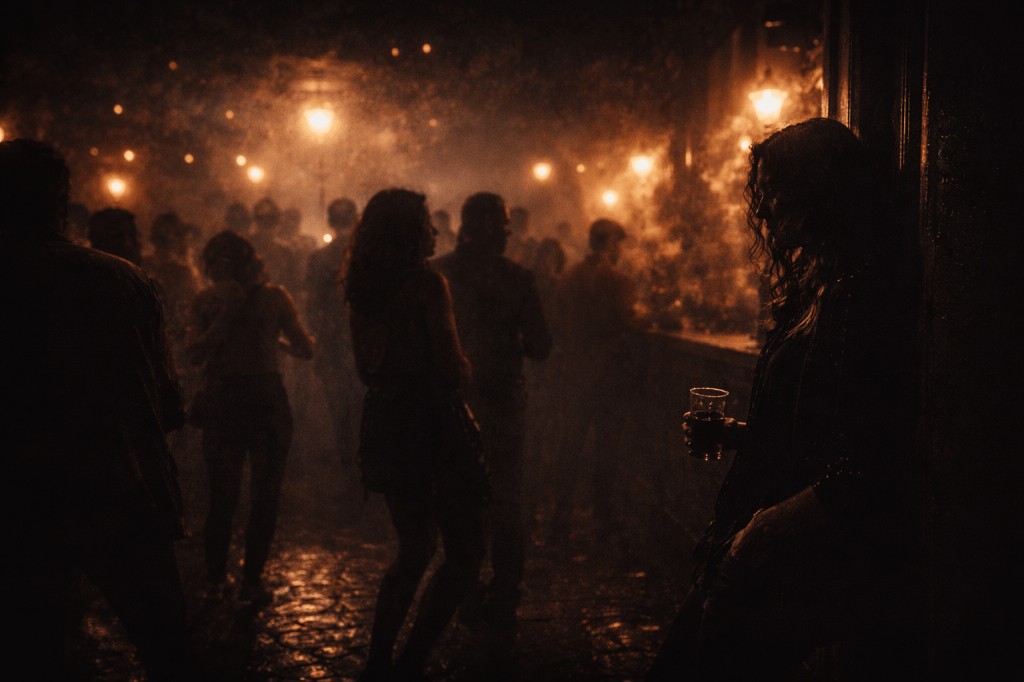
Somewhere — not sure where, maybe nowhere that has a name — the track changes, just a quiet shift, a half-step to the left, and the bass drops half a notch softer, the tempo stretches its long lazy legs, thud… thud… thud…, like the music’s suddenly tired of chasing its own tail and decides to loiter in the doorway instead, smoking a cigarette it doesn’t have, and nobody notices the exact second it happens because nobody ever notices the exact second anything tilts — they only feel the weight settle later, heavier in the chest, heavier in the knees, heavier in the way the eyelids want to stay half-closed.
I’m mid-sip when it catches me, glass suspended halfway to the mouth, pause snagging in the wrist like a thread caught on a nail, and the sound goes syrup-thick, molasses-slow, and the notes smear into one another like wet paint dragged by a tired brush, and the cymbals drag their metal feet across the floor of the mix, and the vocals slouch deeper into themselves, mumbling secrets they used to shout, and the first stupid question is always is it me — is it the drink, is it the hour, is it the old sorrow waking up again — but no, the room’s doing it too, because bodies sway instead of snap, because laughter arrives late to the joke like it got lost on the way, because conversations stretch out long and thin, pulled slow through warm tar, words hanging in the air longer than they should, refusing to land.
The beat says wait. The beat says stretch. The beat says you’ve got time now, all the time you never asked for, time to feel every small ache you usually outrun. And now people no longer dance, they sway, shoulders rocking in that almost-movement way, hips forgetting where the rhythm used to point them, hands floating up toward nothing then drifting down again, unfinished gestures left hanging like laundry in fog, and the air turns dense, chewable, thick enough that you could bite off a piece if you needed something solid to hold onto, something to prove you’re still here and not just drifting through someone else’s memory.
Someone says something sharp and funny and it lands crooked, laughter starts then corrects itself mid-breath, an echo-laugh stumbling half a beat behind like a drunk trying to catch up, and I hear my own voice do the same damn thing — speak, pause, listen to the echo of myself, react to my own words as if they belonged to a stranger, jazz call-and-response trapped inside one skull, one ribcage, one late-night confession that never quite finishes.
The drink’s deep in now. Deep. Thoughts arrive in riffs: short-short-long, stop-start-stutter, ideas snap bright then dissolve into smoke before you can grab them, and memory starts cross-fading everything — past bleeds over present bleeds over the maybe-future that never arrives — and the room breathes, I swear it does, inhales slow through cracked windows, exhales warmer through the old floorboards, because this building’s old enough to remember a hundred nights that pulled the same slow trick, nights when the clocks lied and the heart believed them.
Music dips again, lower, lazier. Someone shouts this is my song! like it’s a prayer they’ve been saving. Someone else groans theatrical and long. Someone else cheers with irony so thick you could spread it on toast. The bass thump lines up with my pulse for one dangerous second too long and I feel that sync, that terrible agreement, when the body says yes to the sound without asking the mind, when feet tap without instruction, when shoulders roll like they’ve been rehearsing in secret all winter, and the night cracks open another careful inch, just enough to let more dark in.
I spot her again — blink-found through the haze — leaning near the doorway like she’s only half-committed to being here, drink cradled loose in her hand, listening more than dancing, head nodding slightly off-beat, as if she’s hearing some other version of the track, a ghost mix no one else gets, and the wanting flares sharp-quick, a match struck in a damp room, then settles back into its familiar pocket, folded small, stored safely where it can’t embarrass me tonight, where it can only ache quietly like an old bruise you keep pressing to see if it still hurts.
The music stretches further, minutes loosen their knots, wander off like strays, seconds drift sideways, and refuse to line up. Someone bumps into me, shoulder to shoulder, and doesn’t apologise because apology no longer feels necessary, because proximity has become the new normal, a space renegotiated without discussion, bodies closer now, warmer now, less polite now, and I realise the music isn’t actually slowing — we are — the sound just holds up a cracked mirror and says look, look at yourselves moving like this, look at how you let it happen.
The beat drops out for a moment, and there’s an almost-silence, a held breath — then it comes back heavier, thicker, a low animal thrum that rises up through the floorboards, pressing upward into ribs and lungs, and the room breathes together, one collective ah, soft and surprised, like we’ve all agreed on something unspoken, something wordless, without ever raising our hands to vote.
Time slides away, spills to both edges of the night, and the dark deepens its grip, and fingers curl slow around the edges of everything, and the music, that lazy liar, keeps pretending this is how it’s always been, this slow syrup drift, this stretched-out ache, this beautiful heavy thing we do to ourselves when the hour gets late and the heart forgets how to hurry.

 Hallway After Midnight