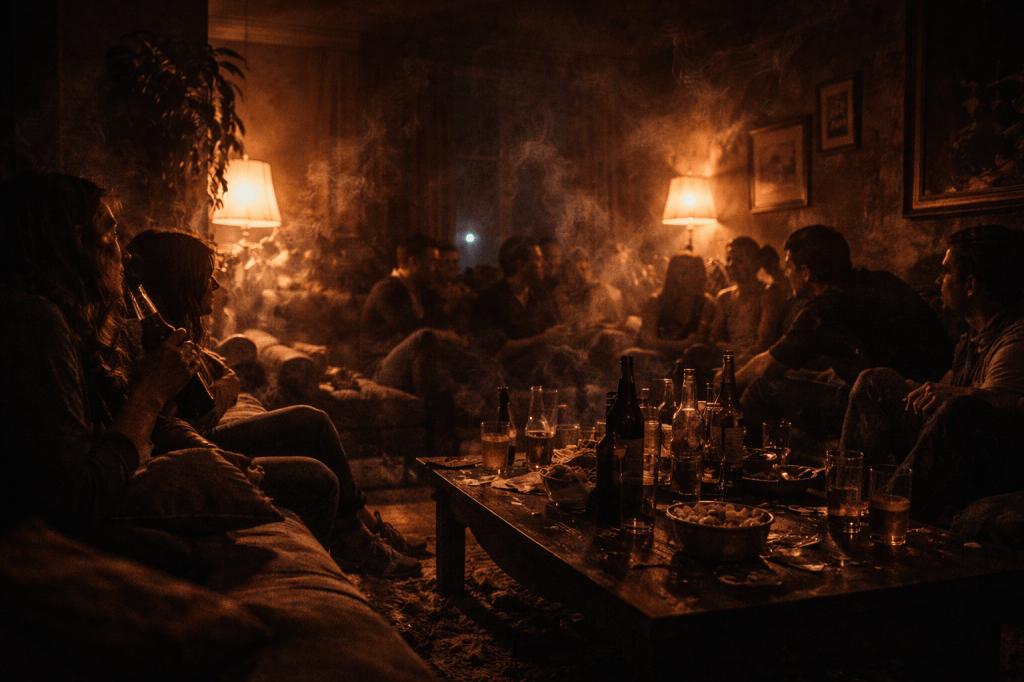
The living room pretends it’s just another ordinary room, aye, sofa parked where sofas have always parked, low table squatting in agreement, lamps spilling their trained, polite cones of light like they’ve been rehearsing this exact performance for decades, but give it thirty seconds—maybe twenty—and the corners start multiplying, quiet and sly, angles breeding in the shadows when your head turns too quick, the whole space doing that soft misbehave where it grows an extra edge, a new bend, just enough to remind you geometry was never trustworthy after midnight.
Music has rooted itself here now, planted deep, and the bass digs thumbs into the floorboards—thud-thud-thud—a heartbeat that isn’t mine but keeps borrowing my pulse, stealing it for a few bars then giving it back slightly altered, warmer, looser. Bodies drift in loose constellations across the carpet, shoulders brush accidental-on-purpose, knees overlap like they’ve known each other longer than the people attached to them, and drinks hover in that dangerous orbit around elbows, amber and clear and fizzing, threatening to spill every time someone laughs too suddenly.
I drift in, glass still lying to me in that gentle, amber way, and the room accepts the intrusion without comment, and folds me into its soft chaos like I was always part of the pattern. Voices layer into a warm roar—talktalktalk—sentences starting strong and brave, then dissolving halfway into laughter, fragments floating, someone gesturing wild with both hands, conducting an invisible orchestra that refuses to rehearse, refuses to stay in time. The walls feel closer than they should be, or maybe further away—hard to tell now, the distance breathes in and out with the music.
In one corner two people argue without words, whole histories compressed into eyebrow flicks, tight smiles and small head tilts that carry years of unfinished sentences. In another corner someone tells a story too loudly about a city they left behind and never went back to, and the voice rises to punch the punchline, but the punchline slips away and drifts out of reach like smoke, and everyone nods anyway because the telling matters more than the ending. I sit. Then stand. Then lean against the wall that feels softer than walls ought to. The sofa swallows me whole, while the cushions rearrange themselves around my shape, then it spits me back out a minute later as if it’s changed its mind.
Every time someone cracks a window the room shifts—air rushes in cold and sharp, curtains breathe in long slow sighs, the outside city presses its damp face against the glass to watch what we’re doing with ourselves tonight. The drink works deeper now. Deeper. Sounds begin to smear at the edges, syllables stretch like warm taffy then snap back, words fuse into new creatures—laugh-slap, talk-drone, bass-bloom—and I find myself nodding along to a conversation I’m only half inside, agreeing with something no one has said yet, feeling briefly, stupidly clever before the thought slides away and another one takes its place.
There’s a plant in the far corner trying its best, but its leaves droop under the heat and the weight of too many eyes, and the soil’s gone dry and unconsulted for weeks, and for some reason that small neglect feels enormous, like a metaphor I’m too far gone to finish, so I let it drop and pick up another thread instead—someone’s laugh, someone’s perfume cutting through the smoke, someone’s hand brushing mine for half a second.
A body moves past, perfume-smoke-sweat in one soft collision, and my awareness jolts awake—that electric oh-moment when the skin reminds the mind it still exists, still wants, still remembers how to feel things before they’re named. I catch my reflection in the dark TV screen—face flushed a shade brighter than normal, eyes too bright, mouth already shaping words before the sentence has finished forming in my head.
Corners again. Too many now. I count four, then five, then six—that’s wrong, that’s impossible—and the room bends its geometry politely, not aggressive, never aggressive, just enough to turn the simple act of leaving into a small, patient puzzle. Doors shift position when you’re not looking. And the hallway behind me exhales slow.
The music spikes—someone’s favourite track, apparently—and a cheer rises sudden and collective, and approval floods the room like warm water, and I feel that dangerous surge, that sweet lie of belonging, the kind that makes you forget to ask what the membership fee will be when the lights come up. Another sip. The lie quiets down, grows more confident, and settles deeper into the bones.
The living room expands inch by inch, corners multiply like rabbits in the dark, stories tangle into knots no one will untie till morning, and the night thickens its grip one small adjustment at a time—shoulders closer, voices lower, bass heavier, air sweeter with smoke and breath and possibility. And somewhere in the extra space that shouldn’t exist, something is already lining itself up: a meeting of eyes that lasts a moment too long, a memory that reaches forward from years ago, a moment I won’t recognise until it’s already passed and left its bruise. The room knows. The room has always known. And it keeps making space, patient, insistent, endless, for whatever sad beautiful wreckage we’re about to leave behind.

 Hallway After Midnight