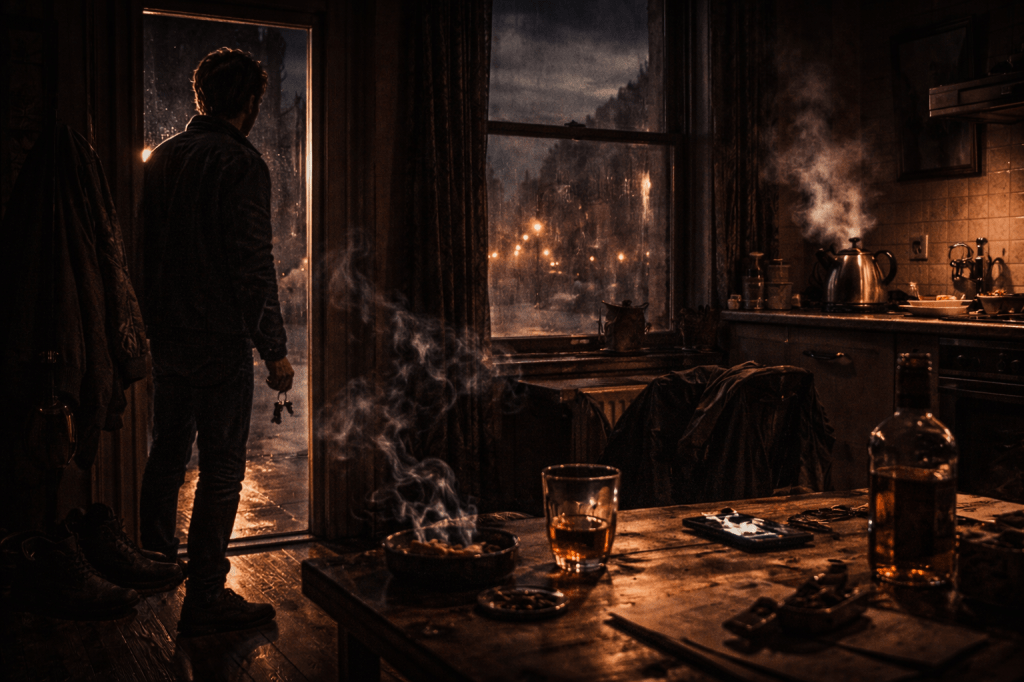
The phone twitches in the pocket like a moth gone mad against lantern glass, zzzt-zzzt-zzzt, unread-read-unread-read-unread, Broughton Square tonight, maybe aye, maybe not, the words sit there heavy as wet wool, and the kettle in the kitchen has turned traitor, screaming its full industrial hiss-fit, and the steam claws at the ceiling as if it knows I’m frozen again in that pre-evening sag, that moment when the day collapses slack-jawed into evening and the night hasn’t yet decided whether to smile or show teeth, and the grey light outside does its tired, sideways bleed across stone that’s been holding its breath since the last century.
Jacket on. Jacket off. Sleeves too tight for the heart that’s suddenly too loose. Glass poured far too early — clink-clonk — and the amber liquid trembles in the low lamplight, already murmuring small philosophies to itself, already telling the first tender lies about how one drink never broke anyone who wasn’t already cracked somewhere deep where no one looks. Shoes wait by the door like impatient dogs, howling let’s-go-let’s-go-let’s-go in their silent leather way.
Keys jangle their jitterbug jazz in my fist. And the reflection caught in the black window looks back at me like a man being talked into something slow and final by the city itself — the city that never rests and never forgives and never forgets the taste of your hesitation, and the door opens, and cold-snap air rushes in, bright and sudden, stinging the lungs awake, and the bus sighs its long low animal breath down the street, and heel-clicks fall like dropped coins on the pavement.
The whole city thrums underneath, that endless scratched-vinyl bass thrum-thrum-thrum, a record someone forgot to lift the needle from years ago, and I walk where streets bend at queer angles no map remembers.
Thoughts skip and scratch — who’ll be there tonight in the smoke and the spill of yellow light, who’s gone for good and left only echoes, who I dread seeing because the sight of them will reopen something I thought I’d finally stapled shut, and who (Christ forgive me) I’m half-praying will step through the doorway glow like an old debt still unpaid, still warm, still bleeding a little.
Night begins to warm itself inside the chest, slow and sly, that pre-drink shimmer where every possibility trembles on the edge of happening and nothing has happened yet, so everything still hurts in the most exquisite, stupid, beautiful way — the way only unstarted nights can hurt, and streetlamps blink slow conspiratorial winks, nudging me forward like tired uncles who know how this story ends but won’t spoil it, and somewhere above, a window breathes music into the frost — bass thud-thud-thud like a heartbeat that’s forgotten how to keep still — voices stacking one on top of another into a laugh-snarl chorus, the party already deep in mid-sentence, already drunk on its own momentum, already forgetting the names it started with before the first bottle was cracked open like a promise no one meant to keep.
Broughton Square arrives too soon, and the walk, the walk, it collapses under the weight of wanting, and here trees stand quiet and black-limbed, looming like old regrets that never quite learned how to leave, buildings squared and stern, Georgian facades pretending they’ve never seen a broken heart stumble up the steps, and the pavements gleam with thin frost, holding secrets older than my shoes, secrets pressed into the stone by generations of people who also stood here once, hesitating, weighing the cost of going in against the heavier cost of going home alone again.
A small internal click-shift happens then — almost audible — the moment the night takes the wheel and I become only the passenger, half-drunk already on the smell of coal smoke and possibility, half-sober with the old sorrow that follows every invitation the way a stray dog follows a man who once fed it, knowing the way home better than he does, and hell, the phone has gone quiet now, sulking in the pocket like it’s disappointed in both of us.
The unfinished drink waits back in the flat, amber and patient, a small amber ghost I’ll meet again later when the night spits me out, and steps fall into a rhythm I didn’t write, didn’t ask for, didn’t want — a rhythm the city drums into your bones whether you’re ready or not, and Broughton Square opens itself at last — soft-lit, side-eyed, patient as ruin, patient as rust, patient as every bad decision that ever felt like salvation at twenty past eleven on a January night — waiting for me to step inside, to cross the invisible line, to become once more another small sad story the morning will forget by breakfast, another name murmured then dropped, another set of footsteps fading into the frost while the square keeps its Georgian silence and waits for the next fool to hesitate at its edge.

 Hallway After Midnight