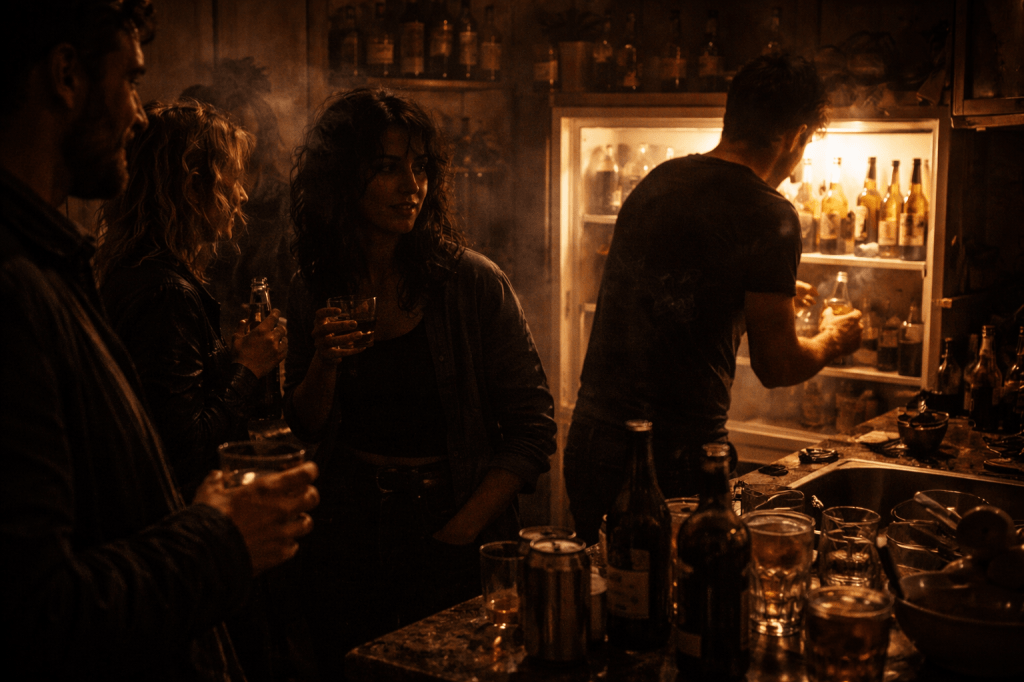
Kitchen first, always the kitchen, that magnet-room, heat-core, where the night drags itself in from the cold to thaw its frozen fingers, and I’m barely through the door before a glass is pressed into my palm — no question asked, no ceremony observed — just liquid appearing like it’s always belonged there, amber-clear something sloshing lazy up to the rim, glug-glint-glug, and I take it because that’s what hands do at parties, they accept the offered thing to keep from having to explain why they shouldn’t, why they can’t, why they already know better.
The fridge stands wide open, spilling white sterile light across ankles and shins, bottles stacked inside like unrepentant witnesses lined up for the trial, and someone leans deep into its glow telling a story that doesn’t need chilling, words tumbling out fast and careless, laughter fizzing up sharp then dying mid-sentence, psht-psht-psht, like cheap soda going flat, and the sink overflows with glasses already — some still clean and hopeful, some suspicious with lipstick ghosts and fingerprints, all pretending they’ll be washed later when the night decides to end, which it never quite does.
First sip. It’s too easy. That’s the first warning bell, soft and sweet. No burn, no cough, no protest from the throat — just a smooth honey-slick slide down, friendly as an old liar’s handshake, already murmuring you’re fine, nothing’s changing, stay a while, and I know — aye, I know deep in the marrow — this is the opening gambit, when the drink smiles wide with all its sharp teeth stored away behind velvet gums. My shoulders drop a reluctant notch. Jaw loosens like a door left ajar. Words start queuing up faster in the back of the mouth, impatient, ready to spill.
The kitchen’s loud now but soft-loud, a conversational roar that wraps around you like smoke, and voices stack like jazz chords gone wrong, and someone talks over someone else who’s talking over the music bleeding through the thin wall, bassump-thrum-thrum-thrum, steady as a heartbeat that’s been running too long without rest, and every surface is claimed: hips propped on counters, elbows occupy the microwave like territory, knees knock cupboard doors open and shut in accidental rhythm, and the whole room pulses like a heart that’s forgotten how to slow down.
I drift, cup in hand, and orbit the edges of conversations without ever quite landing, catching fragments that float past like cigarette ash — no honestly, back in Berlin she said she’d text, I’m never doing that again, swear to god — all of it spoken with that absolute drunken certainty, all of it already untrue before the sentence ends, and I nod at the right moments, and my mouth shapes agreement shapes, and my lips curve into the ghost of a smile that doesn’t reach the eyes.
Second sip, accidental, almost shy. The drink’s changed its tone while I wasn’t looking, or maybe I’ve changed, now that sweetness thins out into something sharper, and the edges blur just enough to feel generous. Someone bumps my shoulder — apology-laugh-apology in one breath — and the contact lingers half a beat longer than physics allows, and skin registers warmth like it’s news from another country, and I feel that internal tilt, that soft dangerous rebalancing where the body whispers aye, we’re doing this now, and the mind pretends it’s still holding the reins, still sober enough to steer.
The kitchen clock ticks something useless — quarter past whatever — and time’s already lost its teeth, and the minutes slide greasily into one another like guilty lovers who can’t decide whether to kiss or run, and the air’s thick and chloroformed, wetter than it should be, and steam rises off bodies and breath and the cheap spirits evaporating from half-empty glasses, and the room sweats its small secrets up into the cracked ceiling plaster.
I refill without noticing. That’s the oldest trick in the book. One moment the glass is low and honest, next it’s brimming again, poured by someone’s hand that vanishes into the crowd before I can thank or accuse, and the alcohol multiplies quiet like rumours in a small town, spreading faster than sense, and now I’m smiling actual smiling, cheeks lifting on their own, a laugh escaping my mouth before I’ve given it permission, raw and surprised.
The lie deepens, burrows deeper. Thoughts hop rails they weren’t meant to ride — the stairwell climb, the cold walk here, the way the night leaned toward me like it had something to confess — and the drink keeps whispering see? this is easy, this is how it’s supposed to feel, making the room seem friendlier than it ever was, making the stories funnier than they deserve, making me forget to scan for exits, to count the doors, to remember why I sometimes leave early.
I lean back against the counter, and let the wood press hard into my spine, grounding and not-grounding all at once, and I watch the kitchen work its slow sad magic: people drift in and out like slow tides, cups raised high then abandoned on every flat surface, a hand traces slow condensation circles on the table like it’s trying to read the future in water drops, and I feel myself slipping into the rhythm without wanting to, breath syncing up to the bassline, pulse finding a new, looser tempo it never asked for.
Third sip, chosen now, chosen. That’s when the lie smiles widest, when the edges soften to the point of mercy, when the colours deepen into something almost tender, when the sounds smear warm and golden at the corners. And somewhere under all the laughter and clatter and thudding bass and endless glug-glug, a small clear voice — faint, fading — tries one last time to remind me that this is how nights choose their direction, not with grand dramatic decisions but with tiny, quiet permissions granted one swallow at a time, one nod, one refill, one more minute that becomes an hour. Too late now. The glass feels lighter in my hand, almost weightless. The night has me gently by the collar, pulling steady. And the first drink, that sweet liar-mouth, leans back against the fridge light, patient, waiting for me to catch up, waiting for the rest of the swallows to follow, waiting for the morning to arrive and prove once again how well it knows me.

 Hallway After Midnight