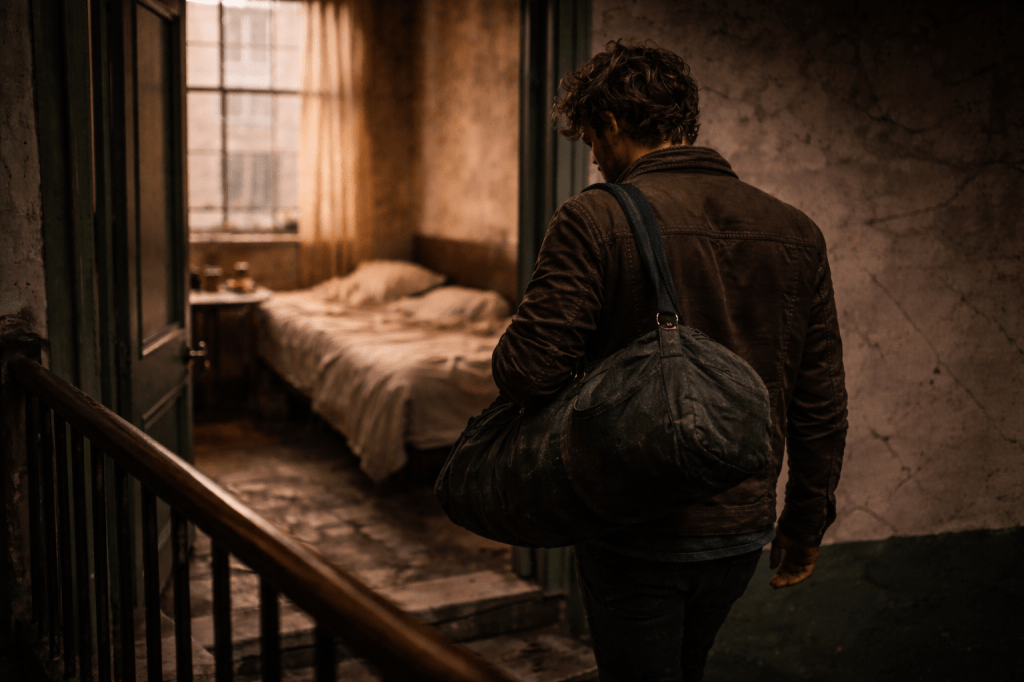
I pack slow, because there’s no hurry when you’ve already decided, and the flat is still holding its morning breath, that half-lit pause where dust motes hang like undecided thoughts and the kettle remembers yesterday’s boil but doesn’t ask to be woken again, and Sorcha’s gone already, boots and bag and sharp mind off toward the uni, toward her plaques and absences and careful dismantlings of history, and I’m left with the quiet click of my own movements sounding louder than they should, every zipper a small confession, every folded thing a rehearsal for disappearance.
It’s not much, what I’ve gathered here, never is, a shirt or two that smell faintly of her soap and last night’s sweat and the ghost of smoke that clings to everything I own, socks paired badly, notebook with the corners chewed soft by rain and thought, the book I never finished because mornings kept happening instead, and I roll it all into the bag like I’m tucking a life into a sentence that refuses to end properly, and the room watches without judgment, walls used to this kind of leaving, Edinburgh rooms always are, they’ve seen worse exits than mine.
The bed is unmade in that honest way that doesn’t pretend to be aesthetic, sheets kicked and folded like a map no one bothered to refold, and I stand there a moment, because bodies remember faster than minds forgive, and there’s still warmth trapped in the mattress like a held note, like something humming just under the skin of the day, and I think about how easy it would be to stay, how staying is always easy for exactly one more hour, one more morning, one more coffee shared in that quiet sideways way where nothing is promised but everything feels possible if you don’t look too hard at it.
But I look, I always do, and the mirror catches me half-packed, half-gone, beard rough, eyes carrying that familiar look of transit, the look of someone already narrating the leaving while still standing inside it, and I see how the flat has already begun to loosen its grip on me, how quickly rooms forget once you stop pretending to belong to them, and it’s not cruelty, it’s efficiency, cities have to move people through or they’d drown in attachment, and I move through the kitchen, touch nothing I don’t need to, the table still holds the echo of her elbows, the chair remembers her weight better than I ever will, and there’s a mug in the sink, hers maybe, or mine, it’s already hard to tell, and I leave it there on purpose, a small unclean ending, proof that I didn’t tidy myself into a lie.
Outside, the stairwell smells like damp stone, each step a hollow drumbeat counting me down and out, and I take them quietly, because leaving loudly would feel like asking to be stopped, and I don’t want that kind of kindness, not today, not from anyone, not even from myself, and by the time the door closes behind me—soft click, the city’s preferred punctuation—I feel the decision settle into my bones with that strange relief that always comes when you choose motion over explanation, and I see that the street is awake enough to notice me but not enough to care, Morningside eases into itself with bakery warmth and bus-sighs and the faint civic confidence of people who know where they’re going, and I move through it like a wrong note that resolves by refusing to linger, bag heavier than it should be for what it holds, lighter than it should be for what it leaves behind.
I think of Sorcha then, inevitably, of the way she fills rooms without asking permission, the way her mind cuts clean through inherited stories and leaves the edges raw and useful, the way she looks at things as if they owe her honesty and usually comply, and there’s no bitterness in the thought, none at all, just that familiar ache that comes when something real doesn’t fit the shape you’re willing to become, when wanting and staying turn out to be different verbs with incompatible tenses, and I know myself well enough by now to trust the pattern even when I don’t like it, the way closeness sharpens me into flight, the way rooms start to feel like questions I’m expected to answer, and I’ve learned that I do better as a passing weather system than a fixed address, that I’m built for edges and intervals and half-lived mornings, for stories that don’t settle long enough to demand maintenance.
So I walk, past the cafés opening their mouths, past the plaques already warming up for their daily recitations, past the soft certainty of people whose lives move forward in lines instead of loops, and with every step the city rearranges itself around me, forgiving me in its own impersonal way, making room for another version of me who will soon be almost convincing.
By the time I reach the end of the street, the flat is already receding into memory, already turning into narrative, already safer than it was when it still had the power to ask me to stay, and I don’t look back, not because it wouldn’t hurt, but because I know exactly how it would, and so I shoulder the bag, breathe in the cold, feel the day take me at my word, and go, because going has always been the truest sentence I know how to finish.

 Hallway After Midnight