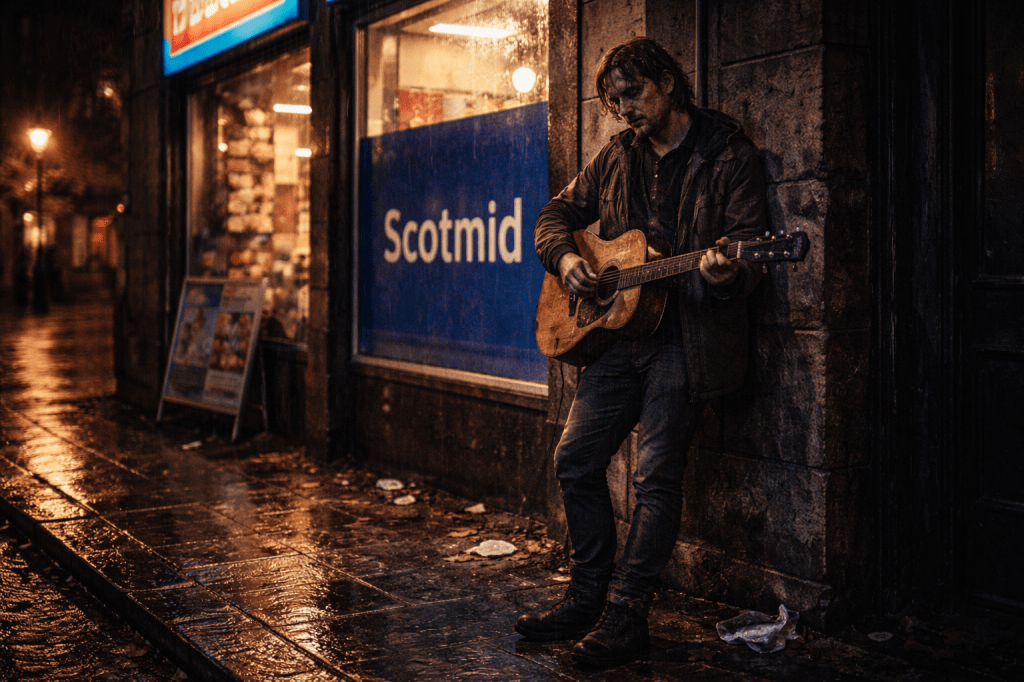
Saw him on a bleak half-evening leaning against the stone lip outside the Scotmid on Dalry, aye you ken the one, the doorway sagging with the weight of discount bread and old Tuesday flyers, and there he was, this wiry lad with a coat too thin for the bonewind, strumming a guitar that should’ve been retired the same decade as its strings, the whole thing bent like it had been left too long in the rain, neck slightly warped, one tuning peg missing, and the sound it made—Christ—wasn’t music, not properly, more like the ghost of three chords wrestling in a biscuit tin, a jangling prayer with half the vowels missing, but he played it anyway with this odd fierce tenderness, thumb beating the rhythm wrong, voice cracking like a confession taped over too many times.
And I stopped—no intention to, just froze mid-step—because there was something in that sound, that off-kilter chordcrawl, like the city had decided to croke its own broken lullaby through this poor bastard’s fingers, and the neon from the shop sign spilled onto him in chopped-up colours—blue-red-blue—like a siren trying to remember urgency but settling for flicker instead, and the pavement around him glowed faint with the shimmer of cheap energy drink cans and raindried footprints left by folk too hurried or too haunted to listen.
He wasn’t young, wasn’t old, he was that in-between age where a man can still pretend his life’s a temporary detour and not the whole map, and his hair fell in damp strands across a forehead lined with more worry than sleep, boots worn to the bone, one lace knotted around itself in a wee stubborn miracle, and he kept playing that relentless three-chord wrongness—thrum-wheeze, clatter-hum, off-bend strum—and each note hits the air like a bird flying sideways into a window but refusing to fall.
Folk passed by in their usual hurry—aye, heads down, eyes dodging everything human—the office lads tight in their collars, the mums dragging the last groceries of the day, students blinking through headphone fog, delivery drivers pacing the pavement like they were paid by the heartbeat—and the busker didn’t look at any of them, didn’t look at me, didn’t look at the world at all, just stared somewhere inward, like he was listening to a tune only he could hear, some melody truer than the mess coming out of the guitar.
And the sound, Jesus, that sound—wrong, aye, but wrong in a way that felt familiar, like how a soul might sing if you woke it up unexpected in the middle of the night, raw and half-formed and not concerned with polish, just trying to get a feeling out before morning clamped its hand over its mouth.
I stood there longer than I meant to, and let the drift of his ragged rhythm shake something loose in me—neither sadness nor pity, just that strange electric jolt of recognising another creature carrying their own private storm, the city’s great chorus of half-lived hours pressing through his bent strings.
And for a moment—aye just a moment—the whole street shifted: the streetlamps dimmed to a softer amber, the traffic noise dropped its snarl, the pavement gleamed like it’d been dipped in memory, and his voice, cracked as a gutterpipe but stubborn as stone, rose above the chaos of the world in this fierce wee flare, a sound that said: I am here, I am here, I am here, even if the tune’s no right.
Then the spell split—a car roared past, the neon blinked, the wind shoved its cold fingers down the back of my neck—and I saw him shiver, adjust his grip, strum again, wrong again, but still playing, still beating that crooked rhythm into the air like he was trying to teach the universe patience.
I dropped a coin in the case—because I recognised the courage in playing anything at all when the world keeps asking for silence. And as I walked away, the sound followed me down the pavement, and it echoed in the stone, jagged, stubborn, three chords wrong and exactly honest.

 Hallway After Midnight