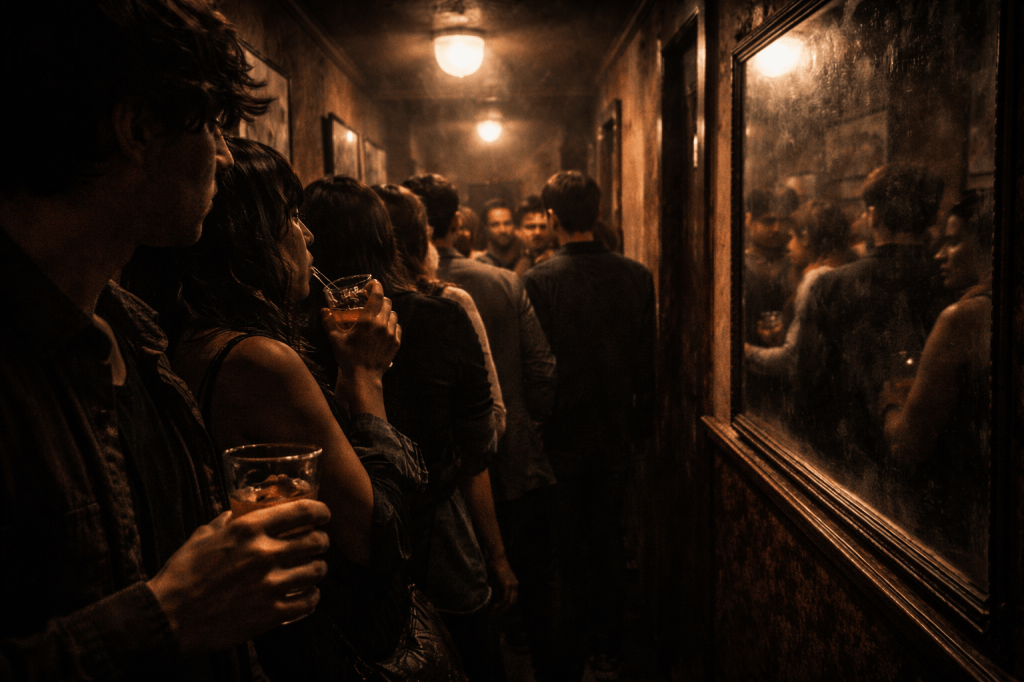
The queue snakes slow and lazy down the narrow hallway like a tired serpent that’s already forgotten why it’s moving, bodies slumped against walls, shoulders brushing picture frames that tilt slightly under the weight of strangers, backs pressed to glass and gilt that never signed up for this kind of intimacy, feet shifting hip to hip in that restless weight-trade dance, each small transfer of balance a tiny negotiation with gravity and boredom and the slow burn of too much wine already in the blood.
I join without fanfare, glass half-full half-warm in my hand, and the wine, aye the wine, fizzes soft and social in the veins while the whiskey underneath drones low and steady, a bass note that refuses to fade, that keeps saying stay, keep going, you’re not done yet. Overhead the hallway bulb buzzes zzrrt-zzrrt, flicker-skip-flicker, throwing everyone into that thin unreal glow where faces stretch longer than they should, shadows creep behind ears and under jaws like they’re auditioning for something darker, and every blink feels delayed, every smile a little too wide at the edges.
Someone three people ahead restarts the same joke for the third time, the punchline forever postponed by interruptions — a cough, a laugh too soon, a phone that buzzes in someone’s pocket — and the laughter lands wrong each time, early then late then ragged, but the line absorbs it all patient as old carpet, because this is what we do here: we wait, we rehearse being alive together, we pretend the delay is the point, not the relief that waits behind the door.
The mirror opposite is cruel in its placement — full-length, unforgiving, catching the whole vertical stack of us at once: a ladder of half-drunk selves, of reflections lagging just a heartbeat behind the real bodies, of eyes brighter than nature intended, of pupils blown wide, of smiles generous in that reckless way smiles get when the night has already borrowed tomorrow’s regrets. I catch my own face mid-something — mid-wince, mid-hope, mid-nothing — and don’t know what I’m reacting to anymore. Mirrors at parties are like that. They overshare. They remember things you were trying to forget.
I look away, then back — stupid habit — and the reflection has shifted already, and now the posture’s slacker, head cocked at the wrong angle, like it’s telling the story differently, rewriting the night before I’ve even finished living it. For a second the quiet wobble hits: is this me or the drink? is this how I look to them? to her? The question hangs unanswered because the line shuffles forward an inch and apparently that’s more urgent, more real, than any truth the mirror might offer.
Behind me a theatrical sigh rises, the sigh of someone who’s decided annoyance is their evening’s costume, loud enough to be heard, soft enough to deny intent. Ahead, polite knocks turn rhythmic, insistent — tap-tap-tap-tap — a small drumroll for the oldest human need, and the hallway fills with the debris of small talk: nearly there, honestly, no rush, I think they fell in, did you see his shoes, god the music’s loud tonight. Jokes grow lazier, laughter louder to cover the laziness, wine whispering red-lipped encouragement in the ear — say it again, say it louder, say it better, make them laugh so they don’t see how tired you are.
I lean into the wall to feel the plaster cool through the jacket, a small anchor in the drift. The door finally opens and a woman steps out blinking against the sudden light, apologising to the entire line in fluttering hands and half-words — sorry, sorry, took longer than I thought — and we all compress, take that collective half-step forward like some mild, drunken evolutionary event, a species learning to inch toward necessity.
Closer to the mirror now, close enough to see the fine print: the flush creeping up the neck, pupils doing too much work, the tiny tremor in the lower lid that says too many hours upright, too much pretending this is fun. Without warning Róisín drifts into the mind — not the full memory, just the shape of her, the way certain people bend gravity around them, pull attention like light bends near a star — and I wonder if she’s ever stood in a queue like this, staring at her own reflection with the same faint suspicion, the same half-question about who’s watching whom. The thought slips away unfinished, fragile as cigarette smoke, because unfinished is what tonight does best.
Inside, someone flushes with unnecessary violence, and the pipes groan long and complaining like tired old men, and the mirror vibrates faintly, and the whole line wavers for a second as if underwater, faces softening at the edges, outlines dissolving into something impressionist, as the night tries on a new filter just to see how we look through regret instead of hope.
I’m next. The door swings open again, and steam breathes out warm and thick with soap and disinfectant and the faint sour ghost of everything the night has already spent, and I step forward one last time caught in the mirror’s steady gaze — my own eyes meeting themselves with that curious, almost polite neutrality strangers use when they know they’ll never speak again. A stray thought flickers: this is how ghosts begin, staring at your reflection long enough that you forget which side of the glass is the living one, which side still owes rent and promises and apologies.
Then the door closes behind me. The hallway noise drops away like a curtain falling. The night rearranges itself quietly, patiently, one small locked room at a time — sink cold under the palms, mirror fogged at the edges, the small click of the bolt, the sudden hush that feels almost holy after all that waiting, all that rehearsal. And for a moment, alone with the running tap and my own breathing, I almost remember who I came here to be. Almost. Then the night keeps moving anyway, and the queue outside is already shifting again, already forgetting I was ever part of it.

 Hallway After Midnight