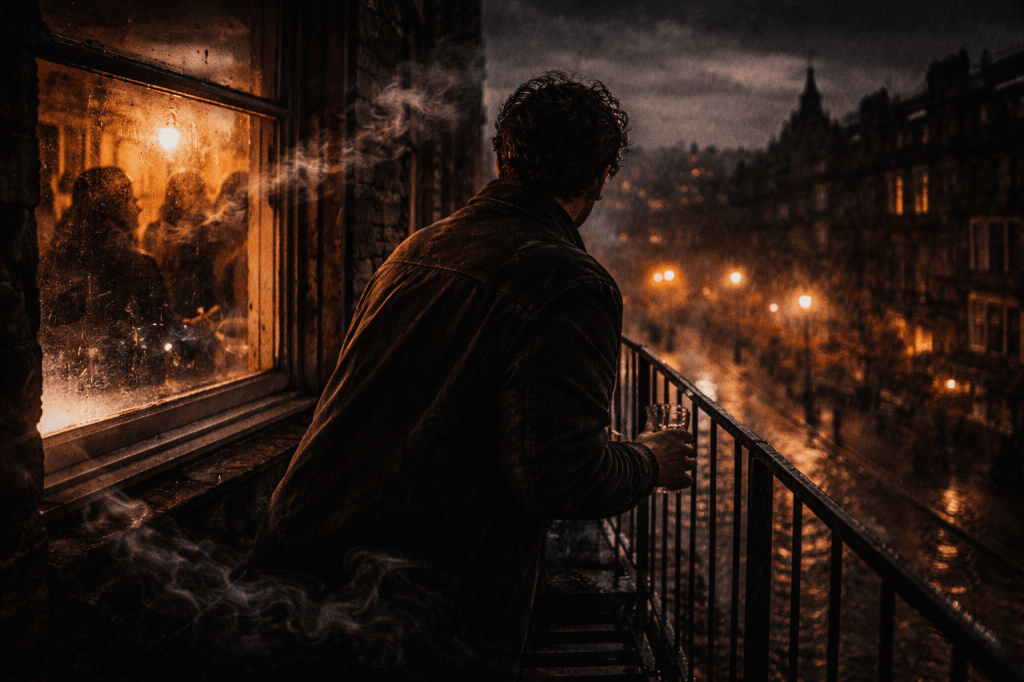
I find it by accident — that’s the only way these small salvations ever show up — a window cracked just enough behind a curtain that’s long since surrendered any pretense at being decorative, where the cold leaks in slow and sly like a rumour nobody asked for, and I slip sideways through warm bodies, muttering sorry-sorry-sorry under my breath, glass held high like some fragile passport to the other side, and suddenly the room drops away, and the music muffles itself to a dull heartbeat, and voices soften into something almost kind, and then the whole party’s sealed behind glass like an aquarium full of mouths opening and closing on nothing important.
Outside, or close enough, balcony-sliver, fire-escape masquerade, iron rail so cold it argues back through the jacket, biting the palms, and the night hits my face clean, sharp, a palette-knife that scrapes away the indoor haze, and my lungs flare awake with a sudden oh-aye-this, and the city air slices straight through the wine-noise and whiskey-hum, cutting channels where breath can finally move again. The whole town stretches itself out below, lazy and unconcerned, streetlights doing their tired amber blink-blink, somewhere a siren starts a thought, tests it, then abandons it halfway like everything else in this city at this hour.
I lean, metal pressed through cloth, cold has texture now, it grabs the skin and doesn’t apologise, doesn’t even pretend it’s temporary. Behind me the window fogs instantly, a breath-smear that turns my outline into soft blur, and I like that — being half-erased, the narrator temporarily excused from his own damn story, the city looking better from out here, flatter, quieter, more honest somehow — roofs stacked like tired books no one will finish reading, chimneys pointing at nothing in particular, Broughton Square breathing its leafy dark below, trees muttering low secrets to themselves in the wind.
I take a long drink. Bad idea. Good timing. Because the alcohol recoils at first, contracts against the cold like a flinch, then spreads again slow and stubborn, and my thoughts go click-scatter-click, jazz brain warming up in the ribs, memory hopping rails without permission — stairwell two years back, Róisín’s laugh sharp and sudden, the door ajar with bed-thrum rising from below like distant thunder, stories stacking themselves in the chest until breathing feels crowded. This is the pause, I think, this little pocket of air where the night holds its breath and waits to see if I’ll stay out here or crawl back inside.
Someone else steps out a minute later, and keeps a respectful distance, cigarette already burning. We don’t speak. We just share the quiet, two silhouettes pretending we’re not eavesdropping on our own lives, and the smoke drifts upwards, curling into the dark like small confessions nobody asked to hear.
The city’s indifferent as ever. A flat opposite flickers blue with TV-light, someone laughs too loud in a kitchen I can’t see, a fox darts across the road below like it’s late for something urgent and ancient, and the cold keeps narrating in its patient, merciless way: you’re outside now, lad, remember this feeling, remember how it strips everything down to bone and breath.
I grip the rail harder until the knuckles whiten. There it is again — that same thought, always the same thought — I could leave, just walk out, down the iron stairs, into the street, let the night swallow me clean and whole, no explanations, no goodbyes, and I sense how the fantasy of exit hums low under everything like a note that won’t resolve. For half a second it feels possible, even beautiful, the clean break, the vanishing act, letting the city fold me into its coat pockets and simply walk away.
But the music surges behind the glass then, and the bass punches the window like a fist, and voices spike sharp and bright, and someone shouts a name I almost recognise, and I know — aye, I know — I won’t go yet. Not now. The night’s not finished rearranging the furniture in my head.
I think of Róisín again — of course I do — think of her position in a room, the way she belongs without trying, the way she listens without collecting debts, and the wanting curls and uncurls inside like persistent smoke that never quite finds the exit. The cold keeps score, breath comes out white for a second — look, you’re alive, it says, look at that small proof — and I laugh quietly at nothing, but the sound’s lost immediately to the open air, swallowed by the same dark that swallows everything else.
The party behind me swells again, impatient, needy, calling me back like a bad habit that knows my name by heart and isn’t ashamed of it. I finish the drink. One last look down, and I push off the rail, and the cold already recedes like a tide that knows it’ll be back tomorrow.
The body remembers warmth, stupidly, gratefully. I step back inside through the fogged window, and the sound crashes over me all at once like cold water turned hot, like heat reclaiming my skin, like faces swimming back into focus, like laughter finding its volume again.
The night snaps shut around me. Outside stays outside. Inside keeps moving, restless, greedy. And whatever choice I almost made slips quietly back into the dark to wait its turn, patient as rust, patient as January, knowing it’ll get another chance when the next window cracks open and the cold leaks in.

 Hallway After Midnight