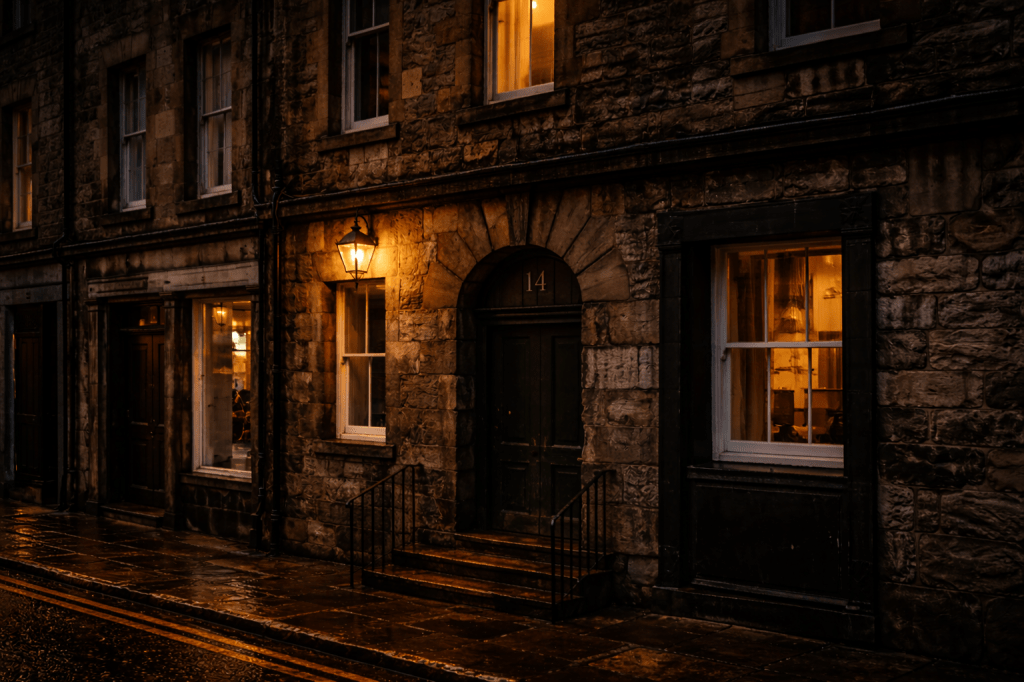
The city changes texture as she climbs and Mara feels it first beneath her feet and then in the air and finally in the way the buildings close around the street, and the younger shopfront brightness of Leith Walk fades gradually behind her while the darker weight of the Old Town begins to gather ahead, and the pavement slabs grow uneven and older and the tenements rise higher on either side like quiet listening walls of soot-dark stone, and the lamps seem dimmer here or perhaps simply older, their light softer and more ambered, and the wind moves differently between the buildings—stonewind slipwind—threading through the narrow gaps and curling briefly along the corners before drifting upward again.
And the stones themselves begin to speak in small patient ways if one walks slowly enough to hear them, because the Old Town is not quiet but full of low layered murmurs—footsteps echoing hollow between close-set doorways, the distant clatter of a bottle rolling somewhere down a side alley, a pub door opening with a burst of voices and then closing again with a muffled wooden thud—and all of it folds into a deeper background hum that feels older than the traffic below, an oldcity murmurhum murmurhum that rises from the stone itself as if the buildings had been storing the memory of footsteps for centuries and were releasing them slowly back into the night.
And Mara walks through it with the same steady rhythm she has carried since the harbor, stepstep stepstep along the wet pavement that glistens faintly beneath the lamps, and the walls of the tenements loom above her with their narrow windows and darkened stairwells and the occasional flicker of television light leaking through thin curtains, and every doorway looks older than the street itself as if the stones had settled deeper into the earth year after year until the whole city became a layered archive of doors and windows and worn thresholds polished smooth by generations of passing hands.
And the smell changes too, and she notices it only gradually while she walks—wetstone irontrace oldwood smokeghost—and the air feels cooler here and heavier with the quiet mineral scent that rises from damp masonry after rain, and the sound of her steps grows slightly louder against the stone walls as the street narrows and the buildings lean inward with the slow gravity of age, and somewhere above the roofs the wind sweeps freely across the ridge of the city where the streets open suddenly over the railway lines and the night air runs unhindered between iron railings.
And she knows she is close now.
Because the stones of the Old Town always lead there eventually, and every street climbing the ridge seems to bend subtly toward that narrow spine where the city crosses the dark gap above Waverley Station, and though she cannot yet see the bridge itself she feels its presence ahead in the shifting air and in the faint widening of the sky between the rooftops, and the stone walls beside her grow darker and quieter as she continues the climb—stepstep stepstep—while the old city breathes slowly around her and the wind carries the distant metallic whisper of trains moving somewhere far below.
 Hallway After Midnight