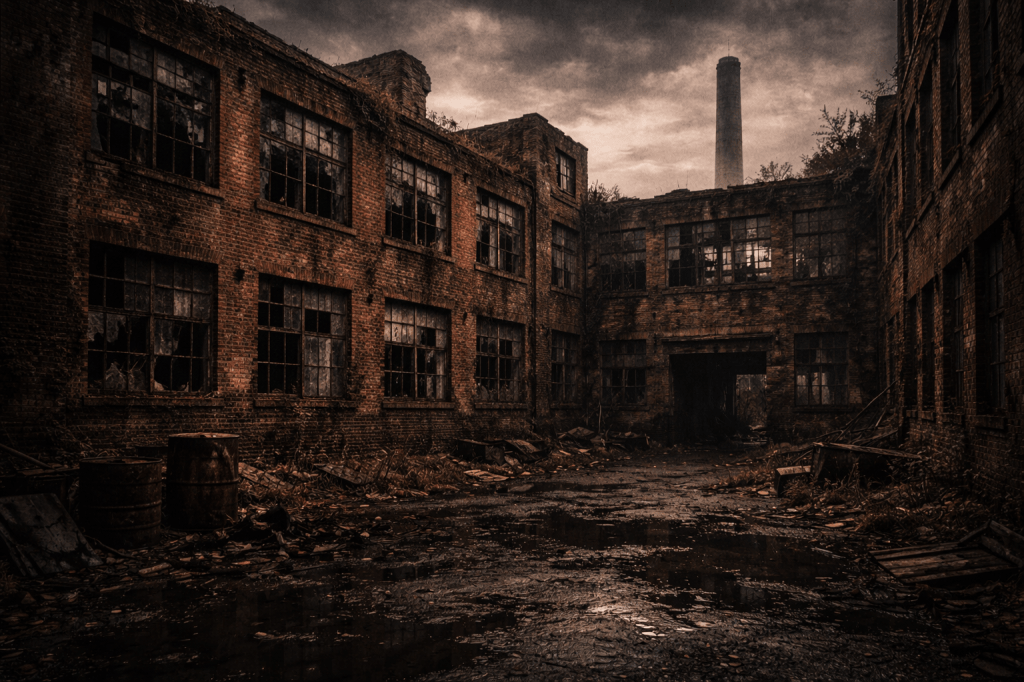
I was thirteen with my head full of rattling hornnotes and stupid courage and that wild boy-thunder that shakes the ribs before the world teaches you what breaks back, and Slateford’s old factory yard lay there like some rust-skinned sleeping monster with its teeth knocked out, windows gummed with moss and cracklines, dead panes grinning in crooked mosaic patterns as if the whole building were smirking at us wee idiots holding stones like sacrament, and the air tasted of brake-dust and damp brick and the kind of silence that isn’t silent at all but packed tight with unsaid things, with half-born thoughts, with the city serenading its low-tide hymn under the concrete—aye lad go on then throw it, ah go on ye wee slingson, show the bones what your bones can do.
We stood there jittering, me and the two pals whose faces blur now into memory-smudge silhouettes, their voices crackling in my skull like cheap radio static—lauch it harder ya dafty, bet ye cannae crack the top yin, lauch it again, LAUCH IT,—while underneath, under their shrieks and bravado, another voice ran colder, softer, not theirs, not mine, but something building-born, bricklunged, wind-fed, the derelict factory’s own throat trying to whisper through the fractures in its skin—glassglass shatterbless lad, let the cracks sing, let the breakwake ring ye clean.
I hurled the first stone and it thunked stupidly off the metal frame with a dull clunk, a nothing-sound, a half-sound, and my mates jeered, and the building seemed to swallow the noise whole like it was storing it away for later, a quiet monstrous ledger of all our little violences, and then I picked up a heavier stone, rough and wet and stubborn, and the voice in my ribs—my own but not my own—started fizzing like a kettle about to boil over, telling me throwthrowthrow, throw the boy you’ll be, throw the boy you won’t be, throw the bit of you that wants to crack something before it cracks you.
And I launched it with all the ragged force a scrawny thirteen-year-old can muster and the pane lit up in a spiderweb bloom of fractures, a bright flash of shatterlight that seemed to pause the air for a heartbeat, the whole yard holding its breath, and then the window let out a thin bansheelaugh that sliced the space open—not a scream, not exactly, more like a sharp glass-jazz note, a high-pitched ha-ha-hhhh that felt alive, felt awake, felt like something had been yearning to break for years and finally found the right idiot child to liberate it.
The shards tumbled out like metallic snow, catching whatever weak sunlight existed and throwing it back at us in jittering knife-glitter pulses, and my mates roared, punching my arm, calling me a legend, a rocket, a madman, but their voices blurred into nonsense as another murmur rose up from the hole I’d made—aye good lad, breakboy, brightboy, mind the cut o’ ye, mind the cut the world will take in time—and I stood frozen, and my heart galloped in my chest like it was trying to outrun the moment.
The factory smelled different then, sweeter somehow, a strange warm drift of dust and memory and whatever ghosts live in old brickwork, and I couldn’t tell if I’d done something glorious or idiotic or both, and the ambiguity grew in me like a bruise made of thought, a purpleswell of pride-fear, fear-pride, this weird pressure behind the sternum that said something happened here lad, and ye’ll no’ quite shake it.
My pals ran off to find bigger stones and bigger legends, but I lingered, staring at the jagged mouth I’d carved in the factory’s face, and the wind hissed through it with a little half-laugh half-warning sound—aye well ye did it now, laddie, the world seen ye, the world’ll keep the mark.
I didn’t understand then. Not really. Still don’t. But I felt something tilt inside me, a hinge creaking open, a future bruise planted deep. And then I ran too, heart jangling, mind jangling, the broken window jangling behind me like a bell that had learned my name.

 Hallway After Midnight