I’m alone in the flat now, neither left-behind nor left-for, just unaccompanied in that after-presence quiet where the air still remembers a body that isn’t currently in it, just a heatprint hanging faint like a ghost-smudge, and the rooms begin their lowroom talk the way they do once they sense you’re listening, and the floorboards tickticktell, and the pipes murmur-breathe last winter’s gossip, and the fridge noise holds a long patient note like it’s waiting for a solo cue, and the kettle cools with a small metal-disappointment sigh because I haven’t needed saving yet.
And I walk the flat slowwise, stepandpauseandhover, not touching at first, letting the shapes sort themselves out around me, and I know this room’s not friend nor stranger but some third thing, a room with undecided grammar, and I feel the old reflex twitch awake—the exit-scan, the window-count, the chair-that-becomes-leaving-chair—but it stutters, misfires, comes back static-crackled, because the room won’t behave, won’t resolve itself into temporary the way other rooms have, won’t flatten itself into a yes-you-can-go-here-but-don’t-stay shape.
And the flat’s a carousel then, becomes all flats at once, a stack-overlap-palimp-room of everywhere I’ve ever been allowed briefly, beds that learned my outline for a night then shed it by morning, mattresses crooning their squeal-spring goodbye songs, kitchens where I stood half-naked and half-already-gone gulping tapwater like absolution, hallways that echoed just enough to warn me not to linger, and I hear the old instruction-voice clear its throat—don’t settle, don’t spread, don’t leave evidence—but it sounds thinner now, warped, delayed, like a tape played at the wrong speed.
That’s when I realise rooms have always been contracts to me, silent agreements inked in dust and fabric and borrowed keys: you may rest here briefly, you may take warmth but not claim it, you may leave no trace beyond a dent in the pillow, and I’ve been good at this, dangerously good, professional-grade invisible, slipping into spaces without disturbing their syntax, never asking what it would feel like to be accounted for by a room, to have a corner expect your body at a certain hour, and this one refuses the deal, this Morningside flat with its diffuse light and stubborn corners and windows that don’t flinch when examined, and I sit on the edge of the sofa—not perching, not claiming, some third posture my body invents on the fly—and the room holds steady, doesn’t shift, doesn’t urge, doesn’t punish, and that unsettles me more than any coldness ever has.
And my thoughts go jazz-wild then, riffspooling, scat-thinking, looping memory shards—mattress-squeal, Pilton stair-smell, Roisín-pressureweather, doorclick-after, doorclick-before, always doorclick—and the patternbeat thuds underneath it all, softthud-softthud, the rhythm I’ve mistaken for character, and the flat listens like a good drummer, doesn’t interrupt, lets me play myself tired, and I start noticing the things I usually avoid noticing, the way the light lingers here, the way the air doesn’t rush me, the way the room seems built to absorb a person rather than eject them, and a thought lands unannounced, heavy-light, paradox-feathered: what if a room knew me past the outline, what if my books touched surfaces, what if mornings stacked one on another without apology or plan, what if I let a space remember me.
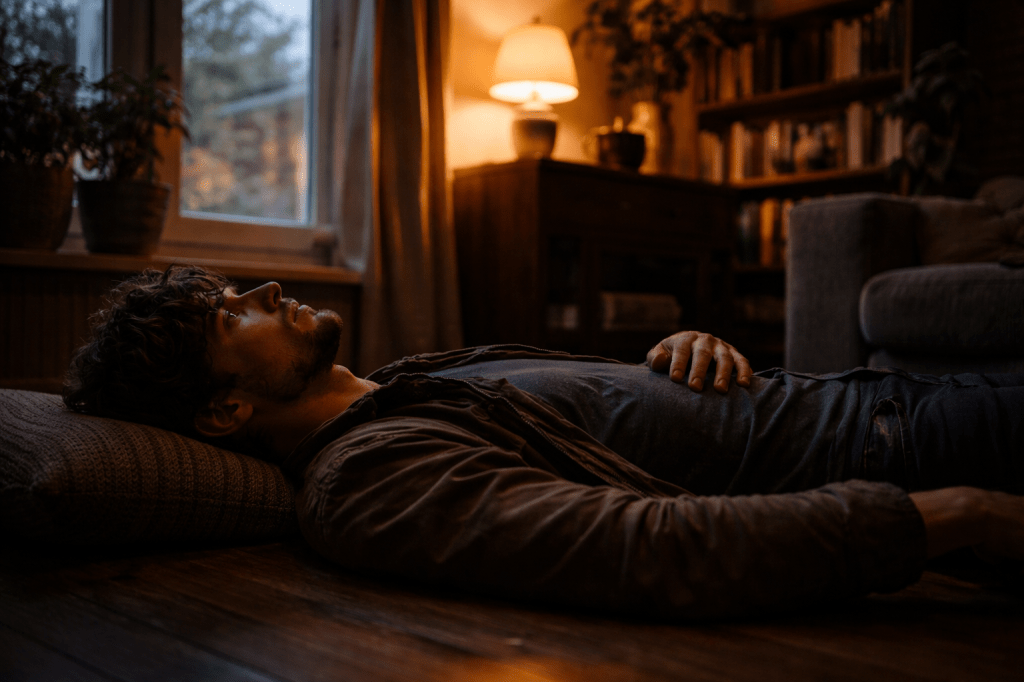
Sorcha is not here but everywhere-in-the-negative, her absence shapes the room like sound shapes silence, sax-ghosting the air, and I feel the tug again, not escape-pull but stay-without-claim pull, a strange new vector that doesn’t point anywhere familiar, and the leaving-impulse circles it like a confused moth, can’t quite land, so I lie back then, on the floor, floor-cold honest against my spine, and I listen to the flat breathe, humwhirr settleclick, and time loosens its belt, minutes going slantwise, and the old urge to rehearse departure grows bored, wanders off to find easier prey.
Because the room holds this, holds me, not promising anything, not asking for vows, just allowing the possibility to remain unclosed, and I stay there longer than usual, longer than advisable, long enough for the thought to register clean and frightening and true: this is how it starts, not with unpacking or naming or future-talk, but with a room that refuses to help you leave and a man who, just this once, doesn’t insist.

 Hallway After Midnight