And I go back for my things the way you go back for a coat you don’t need, light-footed, unpromised, telling myself it’s just retrieval, just logistics, no meaning folded into it, and the stairwell takes me up with its hollow throat-sound, stepandstepandpause, and before I reach the landing the sound finds me first, not noise no but breath-with-weight, a long low wahhh curling round the corners, then a scatter-skid of notes sliding sideways and stopping dead, and my foot freezes mid-lift like the body’s heard something the mind hasn’t caught up with yet.
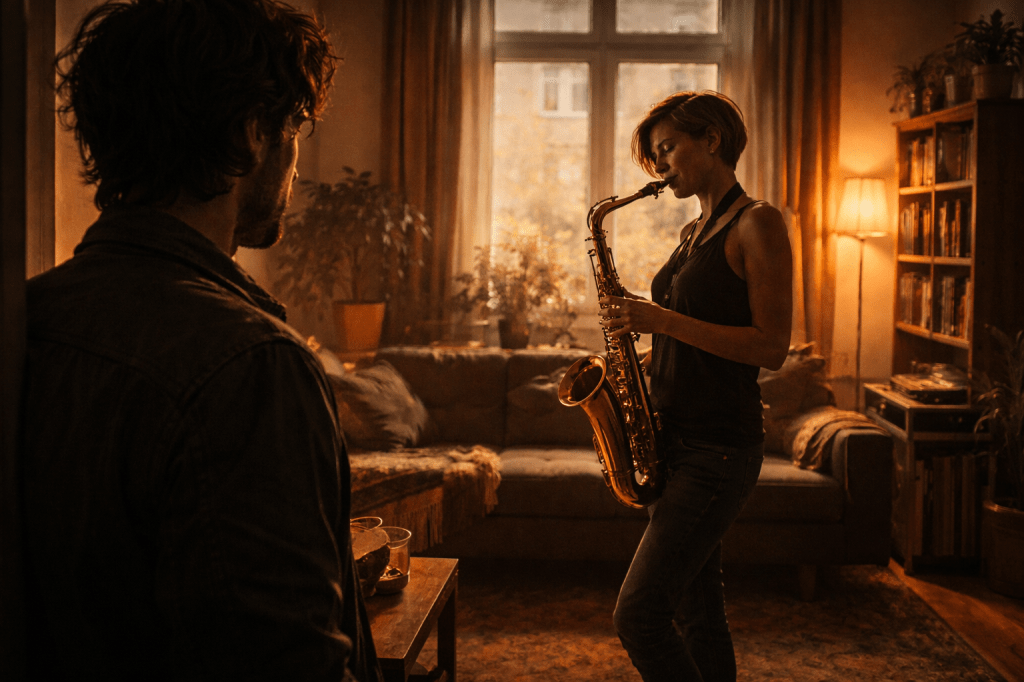
Because it’s coming from her flat, from inside that room I’ve been calling temporary, and the door’s not quite shut, just resting on the latch like it’s listening too, and the sound leaks out in warm pulses, reed-breath and spit-slick tone, the sax speaking in that half-voice that knows how to worry sadness into shape without smoothing it out, and I stand there with my bag strap loose in my hand, not entering, not retreating, the hallway suddenly no longer neutral.
She’s inside, Sorcha, and she’s not performing, not aware of me yet, just working the horn the way some people work through grief or proofs or prayer, body angled forward, hair falling where it wants, shaved side catching the light, and her piercings flicker little syncopations, and the notes come out rough-edged and alive, not club-pretty, not polite, just practice-honest, stretching and bending and snapping back into themselves, a low blues run that drags the afternoon down into its chest and makes it stay there.
And something in me goes quiet all at once, the inventory-noise, the pattern-click, the old exit-maps fold themselves small and slip out of reach, because this is not a role I know how to play, not comfort-man or in-between-body or temporary arrangement, but listener, held-fast, because the sound reaches straight into the ribcage and returns whatever internal metronome I’ve been using to time my departures.
And I watch the way her shoulders move with the phrasing, the way her foot marks time without counting, the way the flat expands under the pressure of the music, and suddenly a whole other city blooms inside those walls, nightrooms I’ve never entered, smoke I’ve never inhaled, histories I haven’t earned but somehow recognise, and I realise I’m holding my breath without noticing, the body learning the shape of staying before the thought catches up.
When she stops, when the last note thins itself into air like it doesn’t want to leave either, the quiet that follows is louder than any conversation I’ve ever rehearsed, and she turns and sees me there, and whatever passes between us doesn’t need words, just the shared recognition that something has shifted its weight, that the room has rearranged itself around the sound and won’t be put back easily.
And I understand then, standing there with my few things still uncollected, that the idea of leaving has already failed, dramatically, heroically, completely, evaporated by a saxophone practising scales in the late afternoon, by the simple fact of her making something and letting it be loud and imperfect and unafraid in a space I’ve been treating like a waiting room, and the decision arrives without speech, without posture, without even a sentence to hang itself on, just a settling, a weight dropping into place where it’s always been meant to sit: I’m not going anywhere, not now, not while this sound exists in the world and I’m allowed to hear it, not unless she tells me to leave, not unless the music itself points me at the door.
And the flat holds this alignment quietly, and the walls still vibrate with reed-ghost and breath-memory, and instead of lifting the bag I put it down, and the afternoon slides into evening without commentary, and the city outside, for once, keeps its distance and lets the sound do the deciding.

 Hallway After Midnight