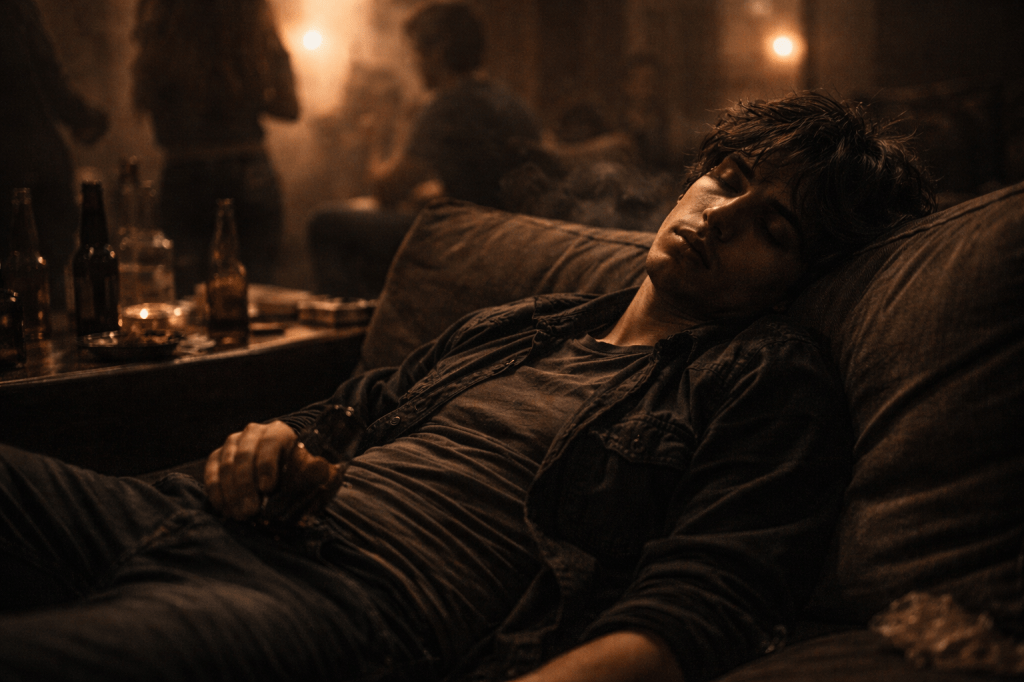
Softnow the couch takes me, the sag-sigh fabric cradle folds around the spine like an old coat that remembers every shoulder it’s ever carried, beerwarm weight sinks deep, eyes in a flutter-slip, shut-open-shut-open-shut, and the room begins to thin, thins deliberately, and the sound peels off sound in slow layers, and the party-murmur drops to a humthread, then less, then nothing but inside, the inside that’s bigger than the room ever was.
Darkagain but not night, not quite — a felt-dark, eyelid-red glow that leaks through the lashes like blood seen through skin, and the city seeps back in through the soles even though the soles aren’t touching anything anymore, seepstone seepbone seepcity, ah the hinging hours where the streetlamps wink-wink their tired gold, exhausted conspirators, and the street below sighs like old men settling into coats they never quite take off, collars turned up against the wind that’s been blowing since the first stone was laid.
And strangely I’m walking-not-walking, couchstill drifting, frame loosening its screws one quiet creak at a time, and Dalry Road slides under me sideways, shopfronts breathing neon-tired, and the 24/7 lights buzz zzzt-awake like insects that never learned to sleep, the bell-ding of the door folds into heartbeat, thud-thud-thud, and I’m behind the counter again and not behind it, coins clattermemory in the palm, till-ring echo chasing its own tail, and the Nocturne pressure sits in the corner by the fridge, not looking, just being — shadowweight with a face I refuse to finish drawing, a shape that knows my name but won’t use it yet.
Tapnow tapthen hushagain — the rain argues with roofs that aren’t there anymore, argue with roofs that never were, and the mattress from before reappears, floor-low, sheet-twist, except now it’s floating, drifting through the flat like a thought that won’t lie down, won’t stay pinned, and Róisín’s laugh brushes past it, a laugh-shade-idea of warmth, leftward, never landing, never quite touching down, just trailing smoke and memory like a cigarette someone forgot to stub out.
Faces unhook themselves. Peelblur. Man-who-was-dead becomes man-who-nods becomes coat slung over a chair becomes nothing, just negative space where a person used to stand. Jamie’s there but wrong-timed, standing in a doorway that opens onto a stair that opens onto Waverley’s ceiling, where the trains breathe iron sleep below, slow asthmatic exhales, and he’s saying something ordinary — lift’s still broken, always is — while naked-why-naked people pass behind him carrying glasses, bodies just bodies, skinlight architecture, no shame, no want, just form-form-form moving through the frame like water through a sieve, and no one remarks because why would you remark on gravity when gravity’s already forgotten how to hold anything properly.
My legs remember cobbles without touching them, clackclack sermonstones chanting their longlow gospel — walkboy walk, keepgone keepstill — and the city threads me through itself, through alleyveins narrow and slick, through stairwell ribs breathing damp, through pubdoor lungs exhaling malt and confession, stale laughter and half-prayers, and the couch beneath me turns briefly into a bus seat rattling over potholes, then a school desk scarred with initials, then the bed from childhood where fear learned how to breathe quietly, how to wait under the covers until the house forgot it was afraid.
Tickpipe. Crackwall. Breathunderbreath. The Nocturne Man leans closer without moving an inch, and the pressure says don’t turn, don’t you dare, and I don’t, because I’m busy watching the future flicker on a wall like bad film stock, me older, thinner, coat too big now, passing the same square in morning light that hurts the eyes, pockets lighter, steps slower, still listening for a voice that only arrives when I’m not awake enough to argue back, when the defenses are down and the wanting has nowhere left to hide.
Words foam up. Rainname streetname lostname. They bubble, they burst, they leave nothing behind, because the city doesn’t speak plain — never has, never will — it murmursround, talks sideways, lets meaning pool in the gutters then slip away down the drains, and I follow because the street’s got my name folded small in its mouth, because the couch hums like a train waiting to depart from a platform no one remembers building, because sleep and wake have signed a temporary truce, shaky signatures, ink still wet.
Somewhere someone laughs and it becomes a door slam and then a fox scream sharp enough to cut glass and then silence, deep silence, the kind that listens back, and the dream tightens its grip just long enough for me to understand nothing needs to resolve, nothing ever did, the loose ends are the point, the fray is the whole cloth. Sharedlung hush. Sharedrib quiet.
Then light leaks pale and polite, thinmorning creeping in like it’s apologising for showing up at all, grey fingers under the curtain, and the city pretends none of this ever happened, pretends the night didn’t borrow your bones for a few hours, pretends the couch didn’t turn into a raft on a river that only flows one way. Eyes open on the couch, and my mouth tastes of old drink and streetstone and a name I don’t say aloud anymore, still lying, still breathing, still becoming — slowly, crookedly, in the small stubborn hours when even the city has to admit it’s tired of pretending it knows where it’s going.

 Hallway After Midnight