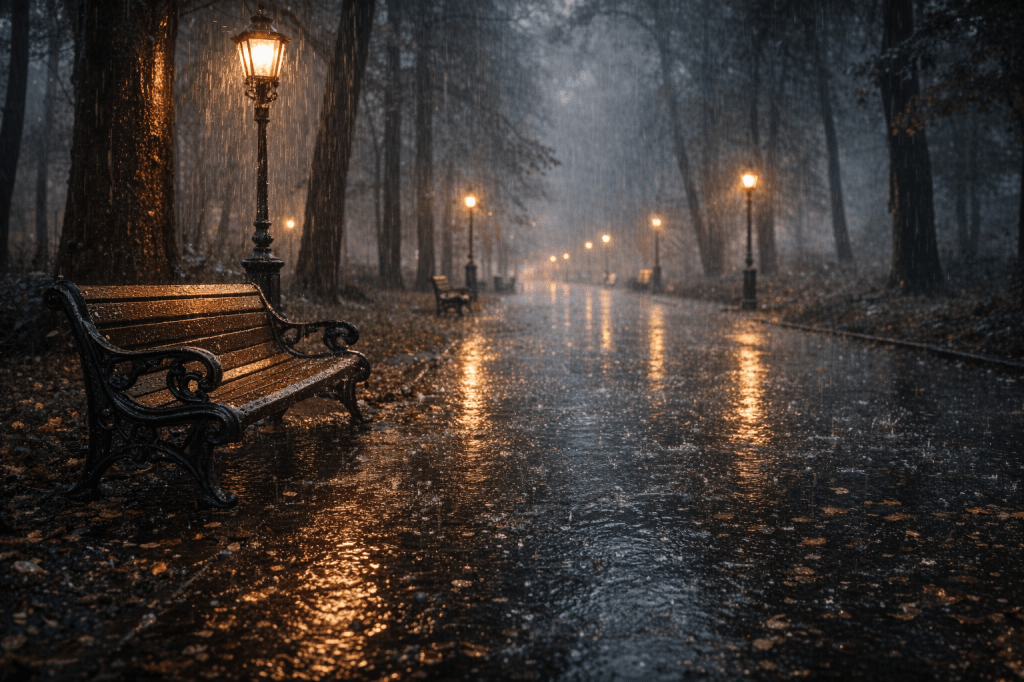
It begins as a soft clicking, a shy little tik-tik-tik on metal railings and bus stop roofs and window ledges and the trembling lips of leaves, and she hears it before she registers it, hears it as a texture in the air, a fine-grained static, as if the city were being tuned by invisible fingers, and then the sound thickens, fattens, fattens into a thousand little drums beating on tin and stone and skin, plipplap plapplip splish, and the pavement darkens in patches like bruises blooming in fast-forward, and the gutters begin their quiet gulping, throat-sounds of a city swallowing itself, and she walks through it all as if through a language she never learned but always understood, her shoes drinking water, her cuffs growing heavy, her hair collecting the weight of small cold stars that melt as soon as they land.
The rain speaks in syllables, and the syllables arrange themselves into rhythms that have nothing to do with mercy and nothing to do with punishment, only with insistence, with the long practice of falling, and she listens to the way droplets ricochet from awnings, tat-tat-tat, and the way the road answers back with a duller, flatter voice, shhrrrk, shhrrrk, and the way the river somewhere below all this is being fed mouthful by mouthful, a slow drinking animal, and she thinks that maybe this is how grief sounds when it is allowed to be honest, not the cinematic sob, not the operatic wail, but this endless, ordinary percussion of being hit by the world and not quite breaking, again and again and again, and she passes shuttered shops where the neon coughs its tired colours into puddles, and the reflections wobble, and her own shape fractures in the water into leg-ghosts and coat-shadows and a head that floats separate from its body, and she wonders if this is what she has been doing for years, learning to exist as a reflection first, a blur, a suggestion, practicing disappearance in mirrors and windows and other people’s expectations, learning how to be a maybe instead of a fact, and the rain makes this practice visible, turns every surface into a rehearsal of vanishing.
There is a moment under a low bridge where the sound becomes cathedral-thick, rain on concrete on iron on echo, boom-hiss, hiss-boom, and her thoughts scatter into small startled birds, and she remembers being younger, standing in a doorway with her shoes already soaked and her mother shouting something about catching a cold, and how she had thought then that rain was a kind of permission, that it excused staying out, excused being late, excused the way time slid off her and left no fingerprints, and now she thinks that rain is just weather, just repetition, just the city practicing the same gesture of erasure over and over, rinsing the names from walls, rinsing the heat from skin, rinsing the certainty from footsteps.
She does not hurry, because there is nowhere to arrive that would be different from this, and the rain keeps falling as if to demonstrate the concept of continuity, as if to say: this is what it looks like when something goes on without you, and she walks inside that going-on, a small moving pause in a much larger sentence, and the city drums itself into being around her, and the sound of water on stone becomes the only language she trusts, because it does not ask her to answer, and it does not care whether she stays or goes, and it will go on practicing its falling long after she has forgotten how to listen.
 Hallway After Midnight