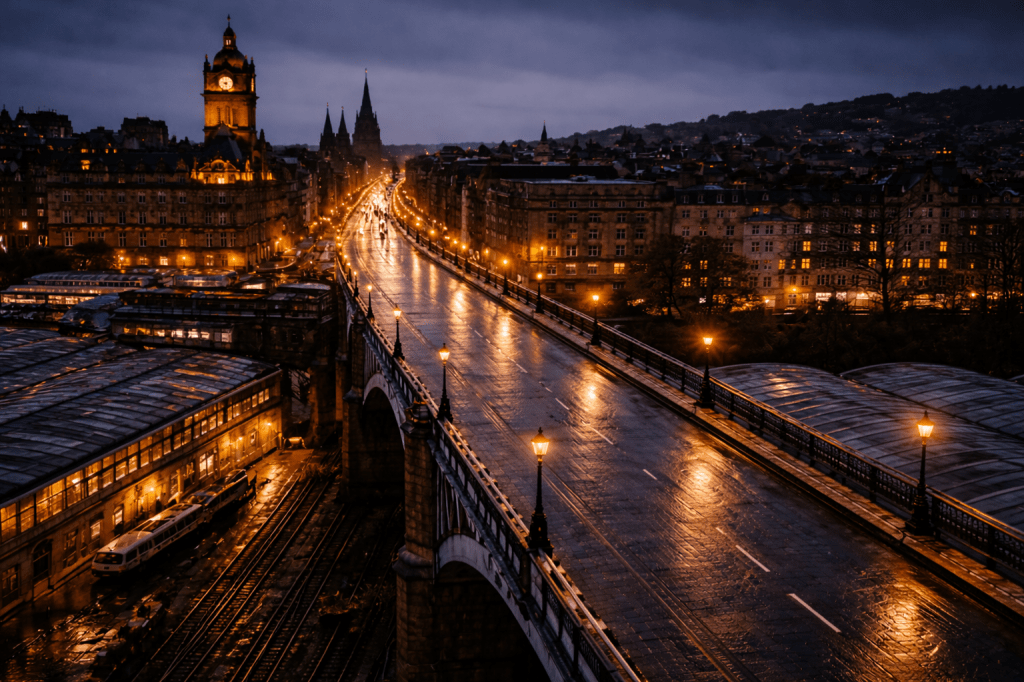
The street opens with that quiet architectural shift the city performs so often, where the close-set buildings loosen their grip for a moment and the pavement widens and the sky grows strangely larger above the lamps, and Mara feels it first in the wind before she sees it, because the wind moves differently here—freewind bridgewind—sliding through the open space with a low restless hushhush that lifts the loose strands of her hair and presses the fabric of her coat gently against her back.
And there they are. The railings rise along the edge of the pavement in a long dark line of iron bars and cold metal joints, their surfaces wet from the rain and glinting faintly beneath the streetlights, and she slows as she approaches them because the city changes again at this place, because the solid continuity of streets and buildings suddenly breaks open into something else, something vertical, and the air feels deeper and wider as if the ground itself had fallen away just beyond the pavement.
She walks closer, stepstep along the slick stones until the iron structure stands beside her at waist height, and she reaches it almost absentmindedly and lets her fingers rest against the metal, and the cold travels instantly through the skin of her hand—ironcold raincold—and she notices the faint irregular texture of the bars beneath her fingertips where years of weather have roughened the paint, and the wind threads softly between the narrow gaps in the railing with a thin whispering sound, railwind thinwind hush.
And beyond it the city drops steadily, a long quiet fall into darkness where the lights of Waverley Station glow below like scattered embers in a deep hollow between the ridges of the Old and New Town, and the rails curve away through the gloom in thin silver lines while trains move somewhere far beneath her with that distant metallic murmur—steelwhirr railhum lowrumble—that rises slowly upward through the night air.
And the bridge itself breathes. Cars pass behind her with the steady roadhiss of tires on damp asphalt and the occasional soft clunk of suspension over uneven joints in the pavement, and somewhere a bus groans briefly as it pulls away from a stop further down the street, and all these sounds blend into a continuous citypulse that moves across the bridge without ever quite stopping, as if the place existed only for movement, only for crossing, never for remaining.
She stands there for a while beside the railings with one hand still resting on the cold iron and the wind sliding past her coat and the open night spreading quietly beyond the bars, because this is the place, the narrow spine of the city where stone streets give way to air and the long structures of iron and road stretch between one half of Edinburgh and the other, and she feels the strange calm that sometimes arrives when a destination finally appears after a long unthinking walk, and the railings stand patient beside her—dark iron, rain-slick, unjudging—while the wind moves steadily through their narrow gaps and the deep hollow of the station glows far below like a distant breathing machine.
 Hallway After Midnight