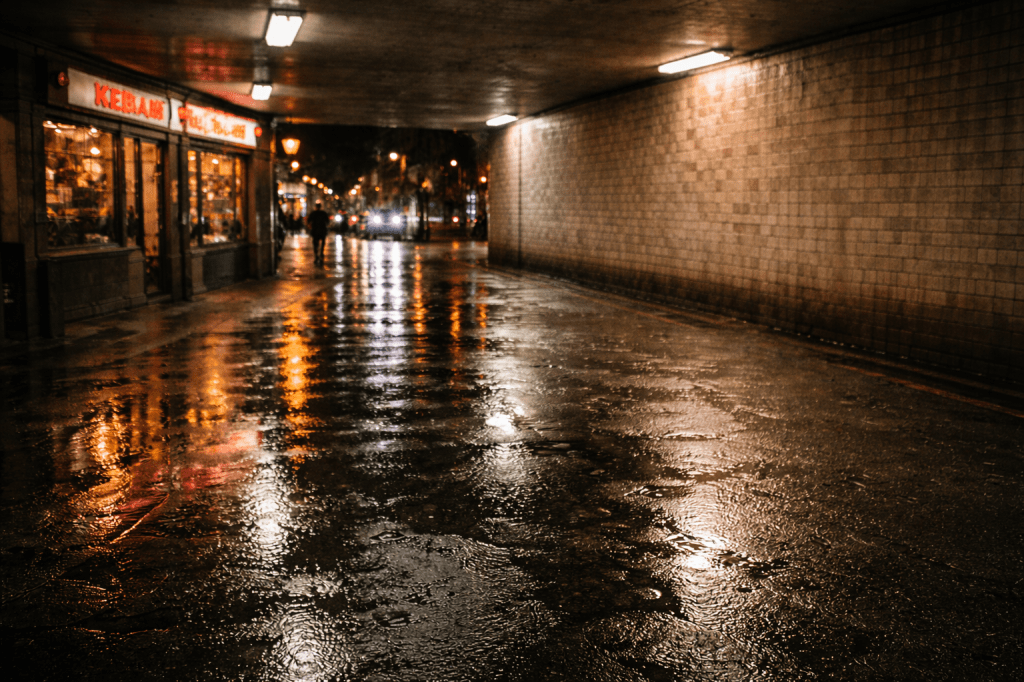
Neon
She passes beneath the underpass where the road thickens into echo and the concrete hums with old tyreghosts and rainmemory and the ceiling drips slow punctuation into puddles that blink back at her like tired eyes, and the light there is always wrong, greenish, sodium-sick, as if the night has learned a different alphabet here and insists on spelling everything in jaundiced syllables, and she walks through it anyway with her hood half-up and her red hair burning dimly like a warning flare damped by drizzle, and the city exhales fumes and warm breath and fryer-smell and old beer ghosts from vents and doorcracks and she inhales without choosing, because breathing is what bodies do even when the mind is elsewhere, even when the mind is looping old rooms and old voices and the afterimage of a hand on her wrist that was once guidance and then became weight and then became something she learned to flinch from, and she wonders, briefly, if flinching is a kind of wisdom, if the body learns before the mind and leaves small notes in muscle and skin that the thinking part will read only years later, footnotes written in ache and tightening and the strange reflex of shrinking when no one is touching you anymore.
A bus roars past and sprays the gutterwater into brief airborne mirrors and the street rearranges itself behind her, and the shopwindows hum with sleepless appliances and plastic mannequins with their blank patience and she wonders, not for the first time and not for the last, how it must feel to be shaped like a promise and never asked to keep it, how it must feel to be assembled for looking at and not for being, and the thought loosens into a wider thought about usefulness and the quiet violence of being wanted only for what you can provide, warmth, attention, softness, the role of being small enough to fit someone else’s loneliness, and she thinks about how the city wants her too, wants her feet on its pavements, her reflection in its glass, her small contribution of motion to keep the illusion of a living organism alive, and she gives it that, gives the city her movement, her shadow, her heat, while keeping the rest folded inward like contraband.
The neon from a late-night kebab place flickers her shadow into double and triple on the wet wall so that for a second she is many girls walking and none of them quite real, all of them stitched from light and rain and the idea of moving forward without knowing what forward is meant to be, and she thinks about forwardness as a story humans tell themselves, a thin narrative string pulled tight across chaos so that steps can line up and become journeys, and she thinks about how easily the string snaps when memory leans too heavily on it, when the past grabs at the present and whispers you are still there, you never left, and she shakes her head slightly as if that might dislodge the whisper, as if thoughts were rain that could be flicked from hair.
She moves past shuttered storefronts where the metal blinds hold onto the day’s fingerprints, greasy half-moons of touch and push and habit, and she thinks about repetition and how days stack like badly aligned plates and how life, for most people, is an architecture of small recurring gestures, coffee, key, door, bus, screen, sleep, repeat, and she wonders where the fracture hides in that, the moment where a life splits into before and after, the moment that never announces itself with trumpets but arrives dressed as ordinary, a normal afternoon, a normal room, a normal voice speaking a sentence that will echo forever, and she wonders if all bridges are built from those sentences, each plank a memory you didn’t know you were stepping onto until the river is already beneath you.
Rain threads down her sleeves and into her cuffs and the cold slides up her skin like a quiet question, and she answers it with motion, with the stubborn insistence of continuing, because continuing is a language she still knows how to speak even when the grammar of hope feels unfamiliar, and she thinks about hope not as brightness but as momentum, the small physics of not stopping, the dull, unromantic miracle of one foot after another, and she thinks that maybe that is what survival actually is, not courage, not belief, not the clean narratives people prefer, but the simple refusal to become still in the wrong place.
The neon trembles and the puddles ripple and the night makes room for her passing, thin room, narrow room, but room enough to keep going, and she walks through this corridor of light and damp and breathing city, carrying the unspoken inventory of herself, the list of things she has lost and the few she has kept, the weight of not-jumping and not-being-saved already forming like a future ache somewhere behind her ribs, and for a moment, brief and fragile, she feels almost buoyant in the way one feels buoyant when nothing is actively pulling you down, and she lets that almost-feeling exist without trusting it, lets it be a passing light on wet stone, a neon syllable in the long sentence of the night, and keeps walking, keeps walking, keeps walking.
 Hallway After Midnight