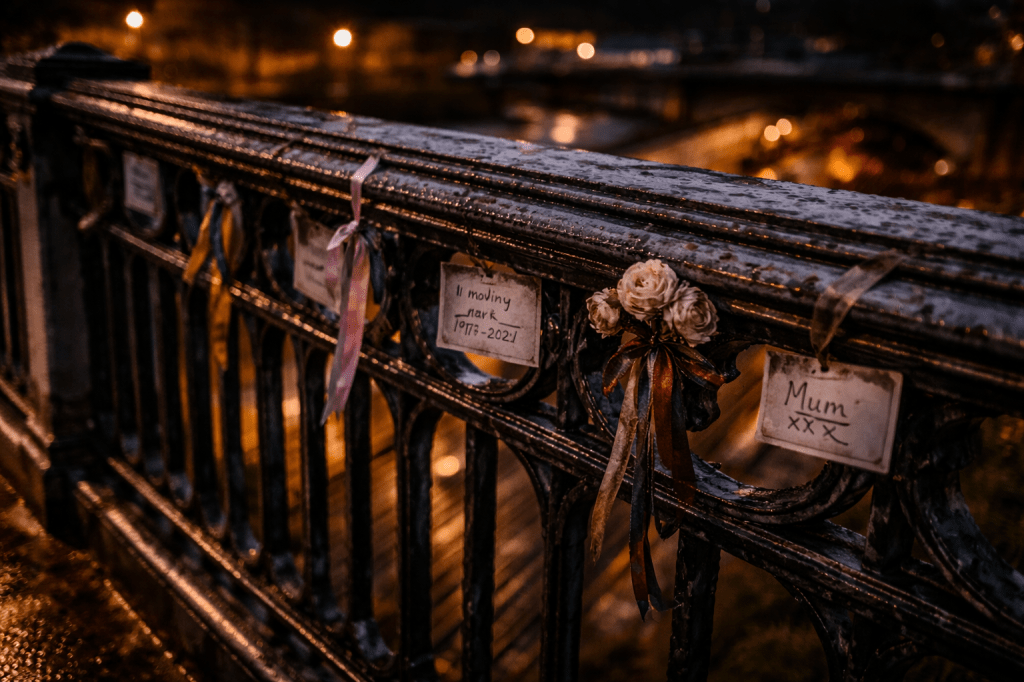
After a while she notices them, not immediately and not all at once but slowly, the way small details begin to reveal themselves when a person stands still long enough beside a structure that was built only for passing through, because the railings are not entirely bare and the iron bars do not belong only to wind and rain and the occasional resting hand, and she begins to see the small interruptions along the metal line—thin ribbons tied carefully around a bar, a strip of faded cloth fluttering lightly in the night breeze, a knot of plastic flowers dulled by weather and time, and the closer she looks the more there are, small quiet offerings fastened to the railings with the patient care of people who had stood here before her and paused in the same uncertain way between the pavement and the open air, and the ribbons are different colours and different ages—some bright and recent and some so pale they have nearly dissolved into grey—and a few of them hold tiny laminated cards or folded notes pressed gently against the iron bars, the ink slightly blurred where rain has touched the paper again and again over the months.
And the wind moves through them, soft ribbonflutter paperrustle hushhush as the thin strips of fabric stir in the slow bridgewind and brush lightly against the iron rods, and the sound is delicate enough that it might almost be mistaken for the whisper of the railings themselves, and she watches the ribbons lift and settle again with the quiet mechanical patience of things that have been left here to remain, and some of the notes still carry names, short names written in careful handwriting or quick hurried marker strokes, sometimes only a first name and sometimes a date, sometimes a small heart or a tiny star drawn beside the letters as if the person writing it had not known what else to add to the empty space, and the paper curls slightly at the edges where the rain has touched it over and over again while the ink holds on stubbornly in dark lines across the surface.
The bridge remembers them all without effort, because the railings do not choose what stays and what falls away, and the iron bars simply hold whatever hands have tied to them in the long quiet sequence of nights that passed here before this one, and the wind continues to move through the ribbons with that soft whispering flutter—hushflutter hushflutter—while the notes tremble gently against the metal, and Mara reads a few of the names almost without intending to, a short name written in black ink that has begun to fade along the edges of the letters, another printed in careful capital strokes beside a small date written below it, and a third one nearly illegible where the rain has washed across the paper until only a few dark fragments remain, and the longer she stands there the more the railings appear less like a simple barrier and more like a narrow archive of small remembered lives.
And the city moves on behind her, cars pass along the bridge with their steady roadhiss and their glowing lamps and the occasional muted thud of tires crossing the uneven joints of the pavement, and the wind rises again from the hollow of the station below carrying the faint metallic murmur of trains entering and leaving their platforms, and the ribbons continue to stir softly against the iron bars as if the bridge itself were breathing slowly through them, and she stands there reading the quiet line of names tied gently along the railings and feels the strange gravity of the place settle around her, because each ribbon marks a moment when someone stopped here and looked down into the same open darkness and did not leave again, and the railings hold those fragile traces of memory in the simplest possible way—fabric, paper, ink—while the wind whispers softly through them and the deep hollow of the city breathes beneath the bridge.
 Hallway After Midnight