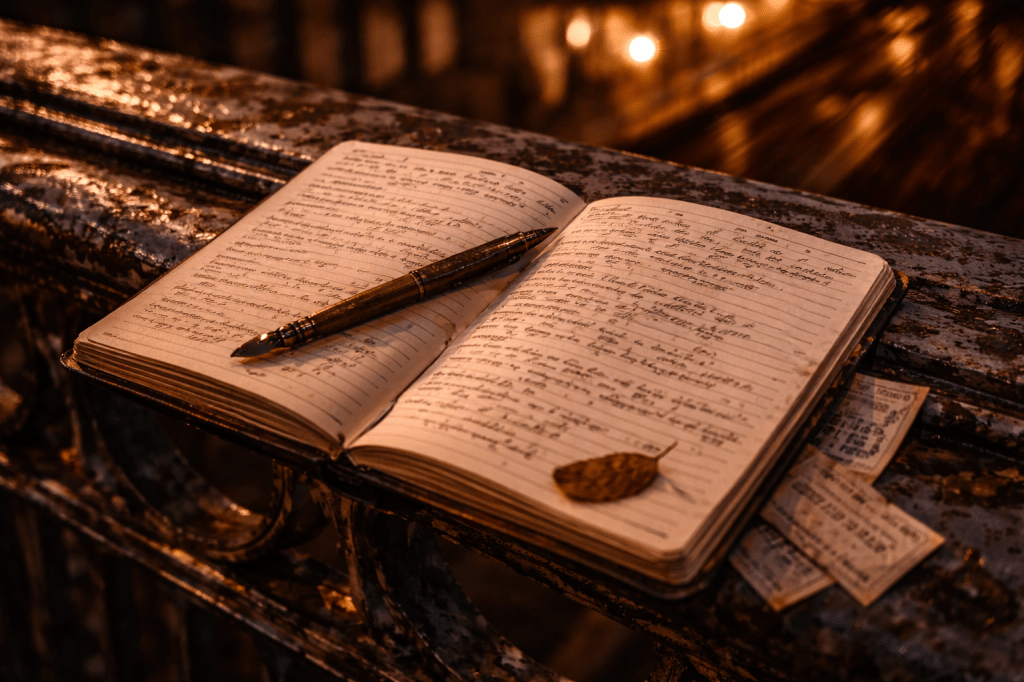
After a while the word forms quietly in her mind—ledger—not because she has read it anywhere tonight and not because the bridge suggests it directly, but because standing here above the hollow of the station with the wind threading the railings and the trains gliding slowly through their patient circuits—steelwhirr lowhum glide—makes the whole city feel like a vast quiet accounting of movement and consequence, every arrival entered somewhere, every departure recorded in some invisible column of time, and she wonders suddenly whether lives themselves are kept in a similar book somewhere, the ordinary days written carefully down beside the rare moments that fracture everything.
And the mind begins its small arithmetic, because memory does not return in stories tonight but in entries—this happened, and then that happened, and then the world tilted slightly and refused to tilt back again—and she finds herself assembling a strange balance sheet of years without quite intending to do so, summer afternoons and school corridors and the first time she noticed how the light falls differently on the stone buildings of the city when autumn arrives early, and somewhere further along the page of recollection the darker entries begin to appear as well, quieter perhaps but heavier, their weight pressing more firmly into the paper of the mind, yet the ledger refuses neatness, there is no clean separation between good and bad, between loss and warmth and the strange half-lit spaces in between, because every memory carries several small annotations beside it—the laughter that followed embarrassment, the kindness that arrived unexpectedly on a day otherwise grey, the evening when the sky over the Meadows burned suddenly orange with late sunlight while someone nearby played the same guitar chord again and again—strumstrum hum—and the present moment here on the bridge inserts itself into the accounting as well, another line added quietly to the long column of being alive.
The strange discovery is that the pages are not yet full, the trains continue to move through the station beneath the bridge with their slow mechanical patience and the wind lifts gently through the iron bars—hushhush railhush—while the city carries on writing its endless record of footsteps and headlights and voices echoing faintly between the stone buildings, and Mara stands there with her hands resting against the railings and realizes that whatever balance the ledger of her life may eventually show, the book itself remains open for another entry, and then another, and then another.
 Hallway After Midnight