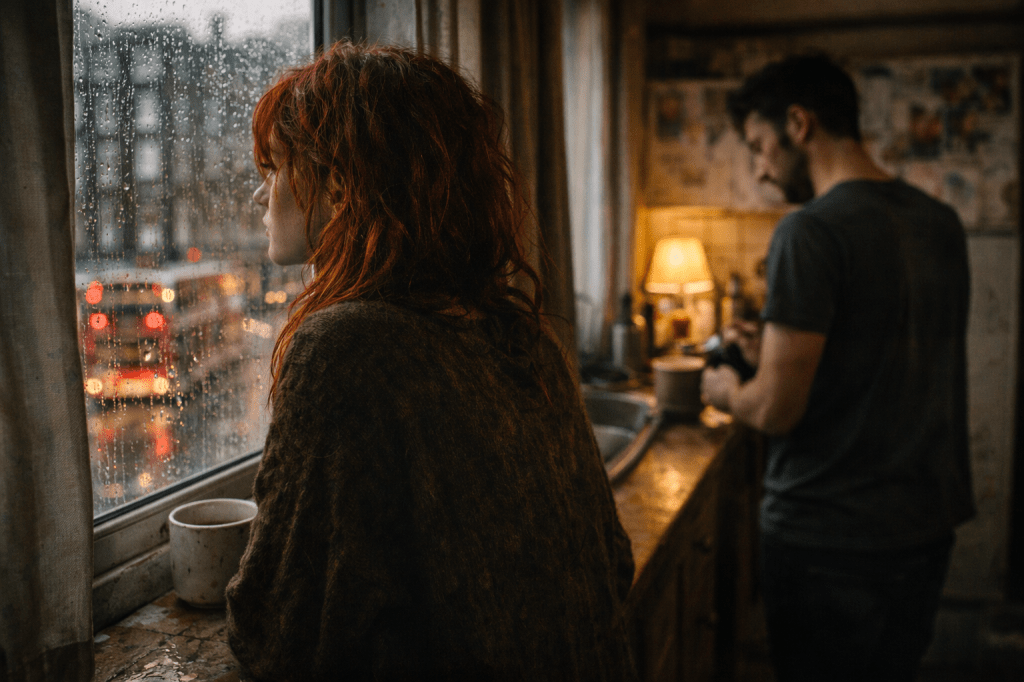
She sits again in a room that is not here and yet insists on being here, a room that flickers up behind the eyes like a faulty slide projector, and it is Leith Walk rain-light leaking through thin curtains that have learned the grey of mornings by heart, and it is a kitchen that smells of burnt toast and cold metal and yesterday’s tea left too long to remember it was once warm, and the table is scarred with small histories of cups slammed down too hard and knives dragged in absent circles and the soft white ghosts of plates lifted too quickly, and she sits with her chin in her palm and the world makes a low refrigerator hum-hummm, a mammalian sound, a breathing that pretends the room is alive enough to keep her company, and the mug between her hands is chipped in a way that feels personal, like it has known her mouth too often and grown tired of holding shape, and the floor carries the faint sticky memory of something spilled weeks ago and never fully forgiven.
And there is the memory of him not as a face but as a movement across the room, the way he crossed from sink to window with the gait of someone who had already decided to leave three days before leaving, and the way his name had sounded when she said it then, thinner, more breakable, as if names themselves grow brittle when spoken too often in small rooms, and the way the window looked out onto a slice of street where buses groaned and sighed and coughed red smoke into the morning, and the way the number 16 lurched past like a tired animal with too many passengers in its ribs, and the way she had thought, briefly and stupidly, that this was what staying looked like, a shared silence and a shared kettle and the soft choreography of two bodies learning each other’s mornings, learning each other’s wrong angles, learning the little rituals of who touches the switch and who forgets to turn it off.
And the room holds its breath around her, and the table keeps its grain under her fingers and the memory keeps its weight under her ribs, and she thinks of how rooms outlive the people who swear themselves to them, how addresses remember footsteps longer than footsteps remember addresses, how walls keep the warmth of shoulders long after shoulders have found other walls, and how she has always been a temporary resident in her own life, a visitor passing through kitchens and beds and borrowed names, leaving small warmth-shadows behind, a trail of almost-heat that fades as soon as she steps away, and how the city is full of these rooms, tucked behind closes off Easter Road and above shops that sell phones and cheap flowers and counterfeit calm, rooms that hold the echo of almosts, of nearlys, of we could have, rooms that learn the shape of disappointment and call it furniture.
And the kettle in the memory clicks off with a soft decisive sound, and she never learned how to click off anything in her own chest, never learned the small, humane violence of stopping before the burn, and even now on the edge of the bypass-world, with the bridge waiting somewhere ahead like a held breath of stone, she carries this kitchen with her, this small square of warmth and failure and almost-home, carrying it like a second, interior room, a place she can sit down in even when there is nowhere to sit, a place she returns to when the present grows too wide and too loud, a place that keeps humming its quiet domestic lullaby, hummm, hummm, hummm, the low-song of appliances and memory and ordinary survival, as if to say: you were here once, and once was real, and real is enough to bruise, and bruises are proof that something pressed close, and pressed close is almost love, and almost is sometimes all the language she has left.
 Hallway After Midnight