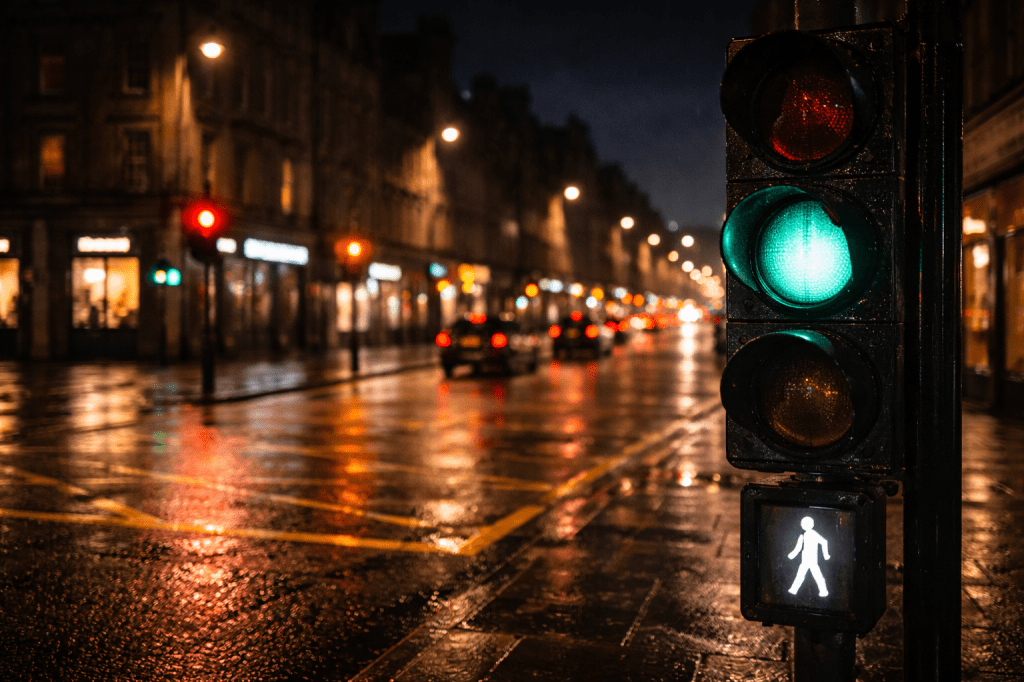
The street widens almost without warning and the slow upward pull of Leith Walk loosens for a moment into an open crossing where several roads slip past each other like quiet currents, and Mara arrives there with the same steady stepstep rhythm she has carried all the way uphill and then slows because the city suddenly feels broader here, more exposed, and the lamps hang higher above the pavement and throw longer reflections across the wet stone slabs, and the traffic glides through the intersection in long patient arcs—headlights drifting, brake lights glowing, a bus groaning softly as it leans through the turn—and the sound gathers in the open air like a low humming chord, citynoise, roadwhirr, a distant metallic rattlerattle of something loose beneath a passing van.
And she stands for a moment near the edge of the pavement where the crossing lines shine pale against the dark asphalt, and the wind slides through the open space between the buildings and brushes her coat with a soft flapping whisper and carries the faint smell of wet stone and late-night cooking oil and something metallic from the tram rails further down the road, and people move through the junction in brief overlapping trajectories—one man striding fastfast with headphones and a knitted hat pulled low, two girls laughing with the bright fragile laughter of people still inside the evening, a cyclist cutting through the lights with a sharp chainclick whirr—and none of them stay long in the same space because a junction is not a place for lingering, it is a place for passing through, a place where paths cross and uncross and drift away again into the grid of streets.
And she watches the signals change—redglow amberblink greenglow—and the rhythm repeats itself with mechanical patience while the city rearranges its movement again and again around the small geometry of the crossing, and for a moment she feels the strange lightness of possibility because from here the streets scatter in several directions and any one of them would carry her somewhere else entirely—down toward the harbor lights again, or sideways into the dim lattice of residential streets, or upward into the older city where the stone closes narrow and twist like old thoughts—and the idea flickers through her mind with a faint electric brightness, turnhere turnthere goanywhere, the whole map of the night briefly open beneath her feet.
And yet the body already knows its direction.
Because while she stands there listening to the low cityhum and the tirehiss and the distant echo of voices drifting between the buildings, she can feel the subtle slope still rising beneath the pavement ahead, that quiet gravitational tug pulling the streets upward toward the ridge of the Old Town, and the lamps beyond the junction appear closer together as the road climbs again between the darker tenements, and somewhere up there—unseen but unmistakable—lies the narrow spine of the city where the stone streets gather and where the air opens suddenly above the railway lines and the night drops away beneath iron railings and wind.
So she crosses. Stepstep across the shining stripes of the pedestrian crossing while the lights hold the traffic back in a brief suspended pause and the cars idle quietly in their lanes with engines murmurmurmuring under the glow of the lamps, and the wind moves again through the open intersection with a long sighing breath and lifts a loose scrap of paper that skitters across the asphalt with a dry skritchskritch sound before vanishing under a parked car, and she reaches the far pavement and continues the climb without looking back because the junction has already begun to close behind her, folding the crossing roads back into their endless patient movement.
And the city resumes its slow upward pull, and her steps fall again into their steady rhythm along the wet pavement—stepstep stepstep—and the lamps stretch into thin trembling lines across the ground while the dark stone buildings ahead gather closer and closer together, and somewhere beyond them the streets narrow toward the older heart of Edinburgh where the wind grows stronger and the night opens wider and the long path she has been walking since the harbor quietly, inexorably approaches its edge.
 Hallway After Midnight