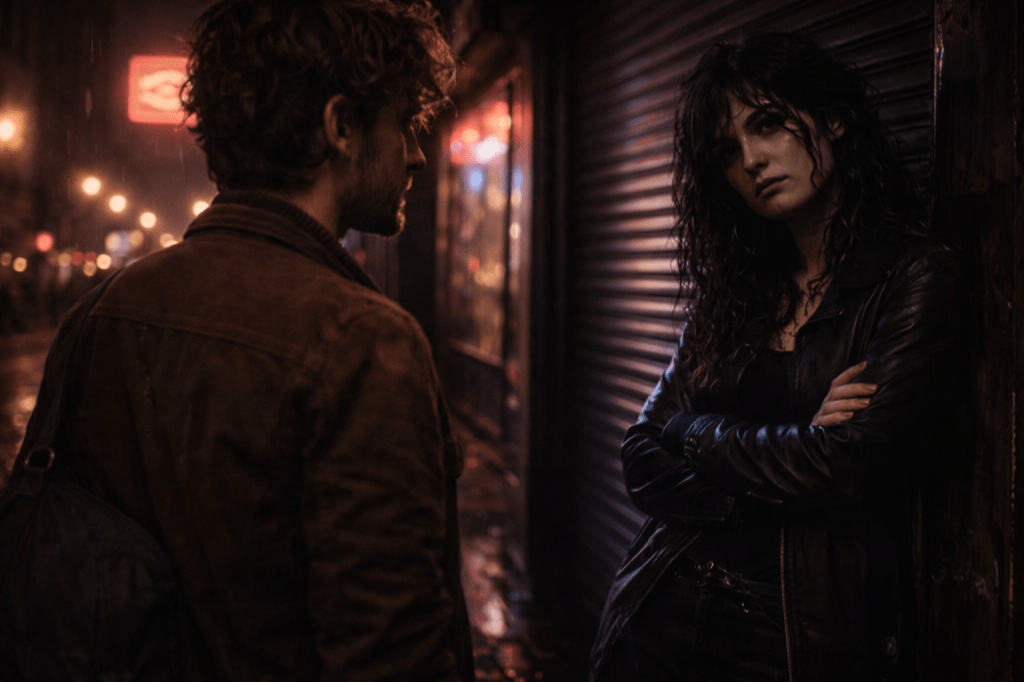
Salamander Street again, wet-lit and half-breathing, the shopfronts blinking tired sodium secrets into puddles that remember more than they show, and there she is, the girl who stood once in the neon rain like a question that never demanded an answer, leaning now with that same sideways ease, coat collar up, hair caught between intention and accident, eyes steady in that way that suggests she has learned to wait without hoping, and she looks at me not like a stranger and not like someone owed an explanation, but like someone checking a weather change, like someone asking the street itself if it delivered what it promised.
And she asks—without asking—whether I found it, whatever it was I went looking for, and the words don’t need to be spoken because they hang there anyway, between us, between the damp stone and the hiss of passing cars, and I feel the answer rise up as inventory, a quiet internal rollcall of bodies and rooms and borrowed warmth.
The mattress woman, inevitably, the one whose floor dipped toward the centre like it wanted to keep you, whose laugh carried that bruised sweetness, whose hands knew how to pull without asking permission, whose flat smelled faintly of dust and skin and something unslept, and I remember the way she slept turned slightly away, as if already practising absence, as if even in closeness she was training herself not to stay.
The girl from Pilton, freckles scattered like a map you could never quite read, cider breath and sudden intensity, the kind of wanting that arrives fast and leaves faster, and how she vanished without ceremony, leaving behind only the echo of herself in certain streets, certain gestures, certain wrong songs that still hit too close when you’re tired enough.
The muralist, though with her it was different, the way she held space, paint under the nails, city dust in the hair, the way she kissed like she was revising something mid-stroke, and how in that case it might have been me who slipped away first, or maybe we both did, simultaneously, without deciding, like two people letting go of the same rope and telling themselves gravity made the choice.
And there are others, of course, smaller impressions, half-women made of timing and circumstance: stairwell encounters, borrowed beds, hands remembered more clearly than faces, moments that felt huge only because they were brief, the city supplying intimacy the way it supplies rain, generously and without promise, and all of it folds back into her question, the girl from Salamander Street, who is watching me with a kind of gentle scepticism, like someone who already knows the answer but respects the ritual of asking, and I realise then that whatever I was chasing—Jamie’s ghost, or the version of myself that might have stayed, or some imagined coherence stitched together from other people’s rooms—I didn’t find it, but I didn’t lose it either, because maybe it was never an object at all, maybe it was only motion, only the act of walking until the question wore thin.
And she nods, or maybe the night does, or maybe it’s just the street settling back into itself, and she smiles that almost-smile, the one that suggests neither invitation nor refusal, just acknowledgement, and we stand there a moment longer, two figures briefly aligned in the city’s long sentence, before the moment loosens and we drift apart without drama, without need, and as I walk away, I feel the familiar tug—not regret exactly, not pride either—but recognition: that I am good at leaving, that I have always been good at leaving, that my talent lies not in staying but in knowing when a chapter has already closed and pretending to read it a little longer.

 Hallway After Midnight