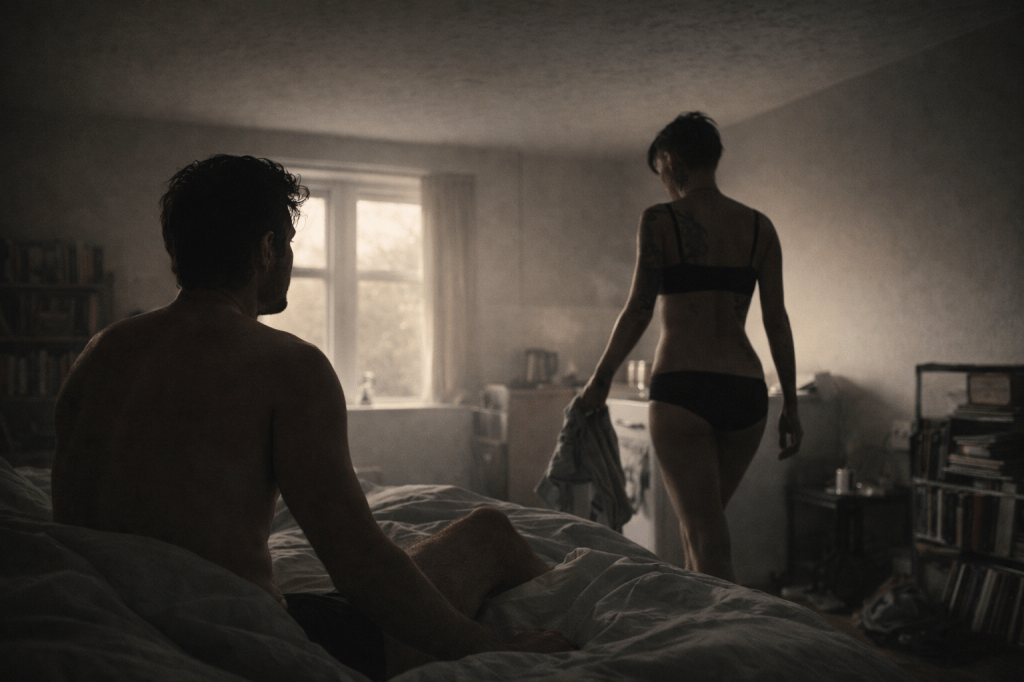
Softwake, softwrong, softwhat-is-this-ceiling, a touch too white, too clean, a ceiling without history, without the nicotine halos and hairline cracks that map older rooms, and this one behaves, it holds the light politely, lets it in by degrees, like it’s been trained, but my skull doesn’t share the discipline, it’s a drum left out overnight, rain-fed, thum-thum hollow, the whiskey-hum still tunnelling behind the eyes, and the mouth tastes of old sweetness gone sour, sugar and carpet and apology. I blink, again, and the air is cold and honest, and the first thing I know—before memory assembles, before regret clocks in—is bare thigh against unfamiliar duvet, boxers as the last defence, one arm numb as if it’s slipped away to start a different life.
The room breathes, floorboard murmurs, a domestic architecture sound, creak-hush-creak, not Dalry’s sermonstone clatter, not Broughton’s partyfloor thunder, but this quieter after-voice of a building clearing its throat and resuming its day.
Movement, then, a woman crosses the far end of the room with the unselfconscious ease of someone who belongs to mornings, no performance, no cover, just panties, black, functional, the truth of underwear without theatre, and I watch her bending to lift something from a chair and her spine draws a clean line through the light, a sentence that doesn’t want interruption, and even the light itself seems different now: grey-gold, undecided, bleeding softly from a sky that hasn’t chosen day yet, turning edges vague, and faces provisional.
For a second I let myself hope, the old reflex, and the name I’d been carrying like a charm pushes forward—Róisín, storm-name, weather-woman, the face I wanted the dark to deliver me to in the morning, but when she turns, when the light settles enough to choose her, the hope collapses without drama, because it’s not her, because this woman is younger, sharper, a different gravity entirely.
Early twenties, maybe, punk, but not as costume but as lived-in necessity, and one side of her head’s shaved back too far, and the other falls in jagged dark lengths like it had been decided with scissors and impatience, and piercings catching light in brief flashes: nose, eyebrow, lip, and tattoos that read as evidence rather than decoration, inked marks that climb her forearm, something starburst-small near the wrist, others disappearing under fabric, private refusing to stay private, a body comfortable in rooms, a body that hasn’t learned to apologise for occupying space.
She looks at me without surprise, without softness, with the practical calm of someone assessing a fact already filed, and I understand, without it being said, that I’m awake later than she expected and earlier than I deserved, and she tells me where I am—Morningside, her flat—in the way people tell you the weather, as context, not as revelation, yet the word lands oddly, Morningside, which sounds like a promise of order, something that believes in routine, dogs on leads, shops that close on time, a village that pretends it isn’t one while keeping careful watch on itself.
I sit up and the room tilts, a slow carnival sway, and my stomach rises then settles, and the duvet slips just enough to remind me of myself, a body borrowed, negotiable, and she notices, not unkindly, and I see there’s almost amusement there, but it’s aimed at the condition, not at me.
Her name arrives simply, Sorcha, and the sound of it snaps something into focus, a spark-name, not myth, not mist, and now she pulls on an oversized t-shirt with a faded band logo half-erased by washing, and it hangs off her like indifference made fabric, and I learn—by implication, by the way she gestures, by the papers spread across the small room, and what she’s going to confirm later—that she studies critical heritage, which might be or might be not history-as-decision, who chooses what matters, who gets preserved, plaque-polished, remembered kindly, what’s allowed to rot without ceremony, heritage as a sharpened thing, never innocent, a language of power, and the way she frames it aligns too neatly with my own habits of letting streets speak, of trusting stone memory more than people.
The flat tells its own story, student-order masquerading as adulthood, books in unstable stacks, a mug on the windowsill with a spoon left standing like a flag, posters about ruins, and contested space, photocopied articles dog-eared from argument, a laptop stickered with causes, everything mid-thought.
She moves into the kitchenette and the kettle clicks on, tick-tick, then the rising hiss, domestic roar, and I pull myself upright, careful, feet to cold floor, the bite sharp enough to wake me fully, and I recover my socks like treasure. Outside the window the Square waits, trees black against the pale, pavements slick, frost that remembers every footfall, streetlamps blinking their tired gold, slowly fading into dawn, and the village breathes in.
Coffee appears in my hands, and its steam curls up between us like a question not yet asked, and she leans against the counter, arms crossed, tattoos shifting with muscle, watching me drink as if gauging what kind of thing I am in daylight, and she mentions, casually, that I’d been saying a name in my sleep. I know which name it was, and I don’t correct anything, but she doesn’t press.
Morningside, she suggests, makes more sense with company, and the way she frames it removes romance but leaves possibility, a choice disguised as convenience. Outside, a bus coughs and groans somewhere distant, a sound like an old animal settling, and a door shuts downstairs, and I understand then that nothing here is going to rescue me, no saints, no storms, just this: coffee, cold air, a woman who doesn’t save but doesn’t abandon either, someone who walks forward and expects you to keep up.

 Hallway After Midnight