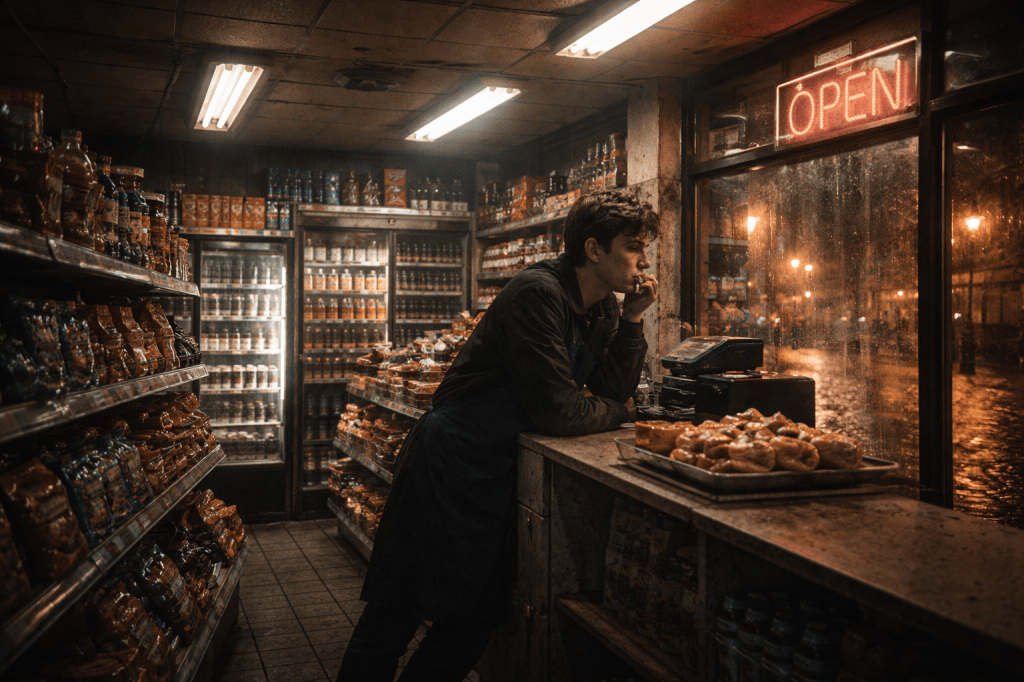
Back then when I was nineteen-and-not-quite-shaped, elbowbones all angles, sleep stored somewhere I couldn’t reach, working the graveyard drift at that wee Dalry Road deli, aye the one glowing its sickly neon throb like a tired electric halo above the door, open always open forever-open like it feared what would happen if it ever closed its eyes, and I’d slide inside through that squeal-sigh door into the thick-lipped warmth of cheap pastries and humming fridges, the air buzzing with old energy, stale hope, microwave ghosts reheating themselves in endless loops, and I’d stand there behind the counter feeling my pulse sync to the flicker of the fluorescent tubes, ker-tack, ker-tick, aye lad, awake-awake-awake, and the night stretched on like a sentence without punctuation.
Outside the buses groaned their stone-old groans, and the engines coughed up tired light, and foxes swaggered between bins like kings of the dark hours, their tails flagging that sly midnight arrogance, and Dalry Road breathed its long petrol breath along the pavements, aye that breath, warm and thin, this breath that shivered with the stories of folk stumbling home or stumbling nowhere, and each footstep echoed in the glass like a wee drumbeat reminding me I was alive enough to hear them.
Inside, the deli aisles shimmered in their own dreamlogic, crisps stacked like brittle neon waves, bottles gleaming like cheap stained-glass windows from a church that had lost its god and found caffeine instead, and every so often the CCTV flickered, aye that jitterbuzz screen that made the place look like it was remembering a different version of itself from an older century, and the shadows walked aisles where nae one stood, and the reflections lagged behind their owners by a half-second, wee hauntings built into the wiring.
The customers came in like stray thoughts: the nurse with her soft bone-tired eyes buying Lucozade as if it held salvation, and the drunk lads roared heavy laughter that slopped over the tiles like spilled beer, and the lonely men clutched their crisps and cans like communion offerings, linger-standing too long at the counter hoping for a scrap of voice, and the night-bus wanderers dragged the cold in behind them as though tethered to the wind, and every so often some kid tried to slip an energy drink into his jacket, failing miserably, muttering a fuckit under his breath and buying gum instead.
And me there, half a ghost behind the till, half a boy, half a world in the hum, breathing in the pastry-sweat air, talking to myself in those Dalry monologue murmurs—aye lad whit are ye doin’ here, whit shape are ye meant tae be, how long can a body stay awake before time folds itself around him like a damp coat—and the hours stretched, thinned, thickened, warped, like the night was kneading me gently but firmly, trying to make something out of me I hadn’t agreed to.
Sometimes around 3:43AM—always roughly then—the whole street outside went silent, proper silent, not dead silent but breath-held silent, a strange hush that fell over Dalry like the city blinked and forgot to exhale, and inside the deli the fridges exhaled their long low oooooooh like monks chanting in a distant crypt, and the microwave lights blinked in slow holy pulses, and the bags of rolls swayed by the door as if something unseen had brushed past them, aye a wee slippage in the air, an eyelash of the uncanny, and for a split second I’d feel the deli detach from the street, drifting soft in the hourglass of the small hours, suspended, hover-quiet, a spaceship of crisps and pies sailing across some fluorescent cosmos.
And I’d step outside for a smoke, leaning against the shut metal of the hairdresser next door, and I watched the sky glow sodium-orange like the gods had set a dimmer switch, and the tenements slouched above like sleepy stone giants, and fox eyes gleamed from the shadow-gap by the bins, and a bus sighed its hydraulic sigh, exhausted from ferrying the city’s insomniacs around in circles.
Then dawn seeped in, aye that pale creep of weaklight crawling up the far end of the road, and everything shifted colour, not bright, not hopeful, just slightly less haunted, and I’d lock the till, count the coins with the soft click-click rhythm that always felt like it might wake some old buried thing in me, hang up my apron dripping crumbs on the floor, step back into the world smelling of coffee, fryer oil, and half-formed decisions.
Dalry Road morning walked me home, walked me through the tail end of my own shadow, the deli hum still echoing in the ribs, the night still clinging to my clothes, and a small quiet truth sitting under my tongue: that some parts of a life happen in hours nobody else remembers, and that the boy who worked those nights still wanders the aisles sometimes, humming with the fridges, keeping time for a version of me who didn’t yet know how to leave.

 Hallway After Midnight