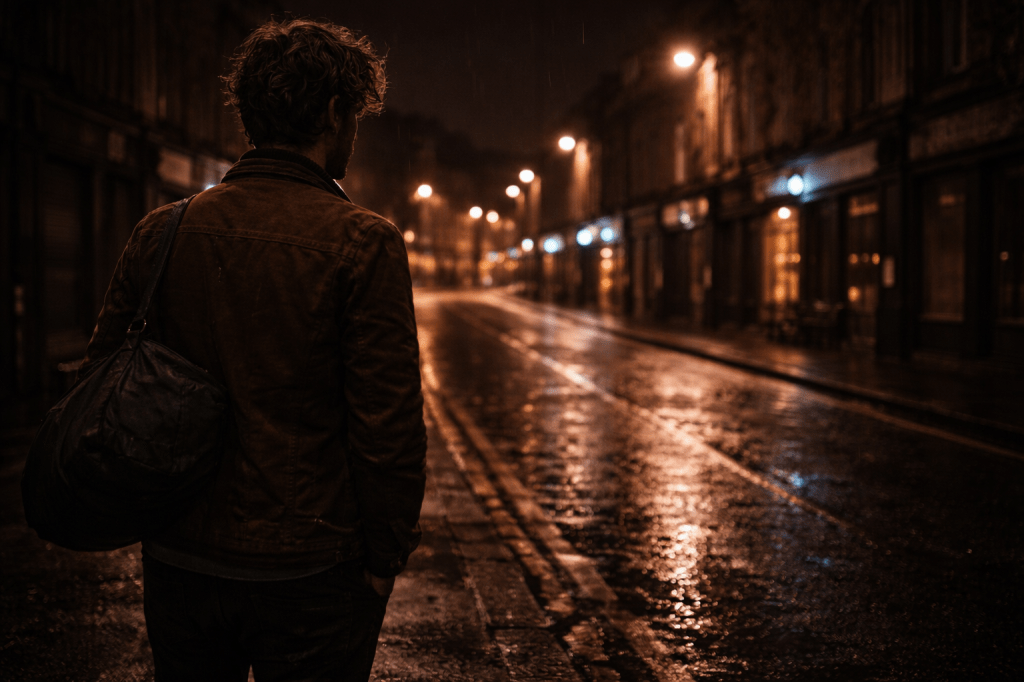
Dalry Road holds itself differently at this hour, not breathing so much as listening, the stones cooled down from the day’s footfall confessions, the shopfronts darkened into their truer faces, shutters pulled like eyelids over tired eyes, and I’m walking slower than I used to, slower than the boy who once stumbled out into this street half-drunk, half-holy, believing every wet reflection might still be a door, and the rain isn’t rain anymore, not really, just a thin suspended damp, a suggestion of weather, hanging there like the city hasn’t decided whether to touch me or not, and the air tastes of old chips and whatever memory the buses drag behind them when they sigh past, empty now, or nearly so, carrying only the last men standing and the ghosts who never learned to queue.
I stop where I stopped before—same lamppost, same cracked kerb, same stain on the pavement that never quite washes out—and it feels less like déjà vu than like reading an old sentence in a book I wrote and forgot, recognising the handwriting but not the hand that held the pen, and the streetlight hums overhead, low and electrical, a lazy halo for nobody in particular, and I wonder how many versions of me it’s illuminated by now, how many almosts have passed beneath it thinking this time is different.
The windows across the road glow unevenly, squares of private life stacked on top of each other like badly shelved novels—someone pacing with a phone pressed to their ear, someone else rinsing a mug again and again as if the day left a taste that won’t go, a television flickering blue nonsense into a room where no one’s really watching—and I feel that familiar ache to imagine myself inside one of those frames, coat tossed over a chair, name known, future temporarily agreed upon, but the tug loosens quicker now, and that’s new.
A fox darts out from between two parked cars, pauses just long enough to assess me with that unimpressed stare—ah yes, you again—and vanishes toward the bins with the efficient grace of something that belongs exactly where it is, and I envy it, briefly, then let the envy pass. Even foxes have routes they don’t question.
My pockets are lighter than they were back then, fewer keys, fewer excuses, no cigarette, no loyal last soldier bent and ready, just my hands, cold enough to notice themselves, and the quiet understanding that there’s nothing left to wait for here, not tonight, not in this shape.
Dalry Road never argues. It lets me stand there forever, lets the memory residue settle, lets the echo of earlier footsteps dissolve into the stone, and the street feels neither cruel nor kind, just complete in the way places become when they’ve finished teaching you whatever lesson they were holding back, and a bus passes without stopping, and the wind lifts, then thinks better of it, and somewhere a door closes, soft, decisive.
I turn, finally, and walk away—not fleeing, not lingering, just moving because movement is what I’ve always been best at—and the street recedes behind me without ceremony, slipping back into itself, into repetition, into the lives of others who will arrive believing what I once believed, and as I reach the corner, as Dalry Road disappears from view, I don’t feel loss so much as release, the clean, unfamiliar weightlessness of not needing a sign.
Aye, the city goes on. And so do I.

 Hallway After Midnight