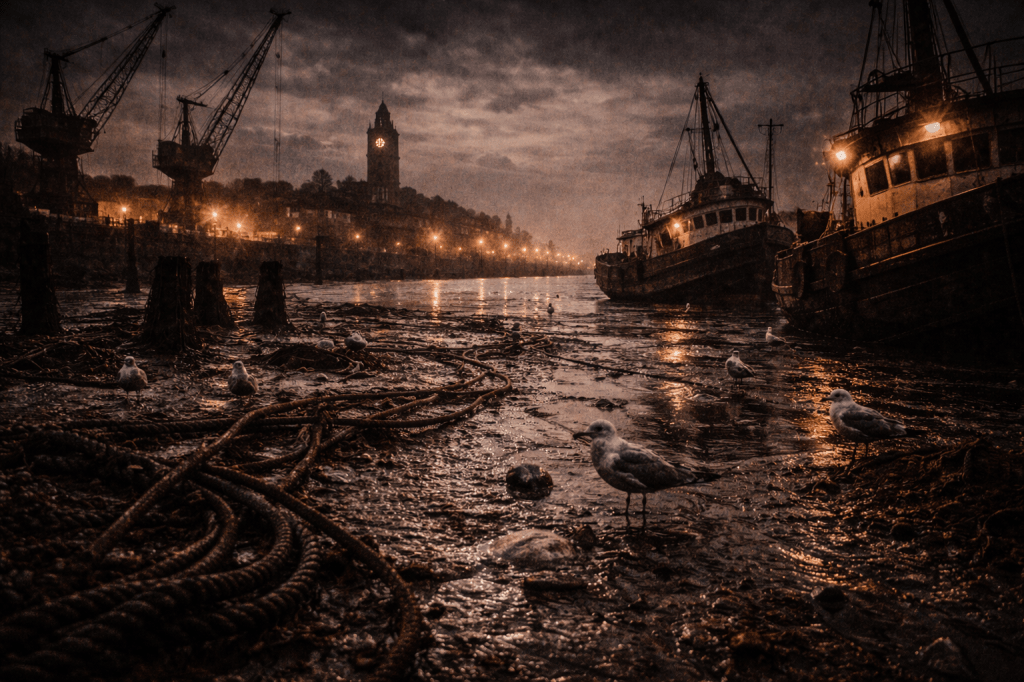
Low tide at Leith and the whole harbour pulled its wet lips back in a slow crooked grin, and the mud-belly shone like some sea-god’s opened wound, and ropes snaked across the glistening earth in limp dead-drunk spirals, and gulls stalked like white-suited undertakers looking for loose souls, and I stood there with the salt biting my teeth and the wind chewing its cold grammar into my ears—saltsharp mindwake, tidebreak boyo, keepstill keepstill—and the cranes loomed overhead like giant metal saints fallen on hard times, arms frozen in a question they’d been trying to ask for a hundred years but couldn’t quite spit out.
The air hit different down here, a kind of bone-deep brine that crawled under your skin like an old memory you didn’t consent to remember, a taste of rust and far-off storms and something older than language, older than thought, older even than the city that kept trying to pin its worries on the sky; and I breathed it all in like some deranged monk gulping his first mouthful of holy spirit, the salt stinging, the cold slicing, the whole world spinning in that low-tide hush where existence revealed its seams and showed you how shoddily it’s been stitched.
The clocktower stared out over the slackwater-flat horizon, ticking its stern little heartbeat like it’s calling time on the entire human condition, that solemn Leith clockface looking at me as if to say aye lad, you’re temporary, don’t get precious, and I swore for a moment the hands twitched faster, jittering in a jazzburst staccato like the universe itself had the shakes, like the minutes were drunk on brine and losing their grip on linearity, and I stood there half-dizzy thinking maybe time didn’t pass here, maybe it just sloshed around restlessly waiting for something worth obeying.
A gull let out a scream so sharp it felt like it sliced a thin strip off my soul and tossed it into the muck for inspection, and I watched that muddy expanse—kelp snarled like drowned hair, chains rusted to brittle bone, shattered glass blinking like lost warnings—and I thought how every forgotten thing ended up here eventually, the sea the great collector of our dropped errors, our mislaid hours, our unspoken griefs, and at low tide it spread them all out like tarot cards saying interpret this if you can, lad, and I couldn’t, not really, and I can’t, not ever.
The wind barreled in from the Forth with its own cracked philosophy, a kind of brute-force wisdom written in cold slaps, telling me without words that the world was bigger than my bruises, smaller than my fears, older than my questions, and absolutely indifferent to whether I managed to answer a single one; and something in that indifference comforted me, steadied me, told me I could let myself be small without disappearing.
The mud squelched under my shoe, and sent up a smell like ancient kitchens and shipwreck myths, and for a split second—one insane salt-lit heartbeat—I saw the whole shoreline flicker into another shape, some great leviathan spine curled under the harbour, as if the land itself remembered the deep bodies that once moved through it, and I felt the ground shake under me as though it’s whispering we were water once, all o’ us.
The tide began its slow crawl back—thin ribbons of water slipping forward like soft apologetics—and I felt the pull in my ribs, a tidepull, a clockpull, a somethingpull that had no name but hit me with the quiet force of truth, and the salt on my tongue turned into a thought that wasn’t shaped like language yet still said something clear: move when it moves, stop when it stops, breathe when it breathes. And I let myself stand there in the raw sea-breath of Leith, half alive, half dissolved, the tide rising, the world turning, the salt writing small poems on my lips that meant nothing and everything all at once.

 Hallway After Midnight