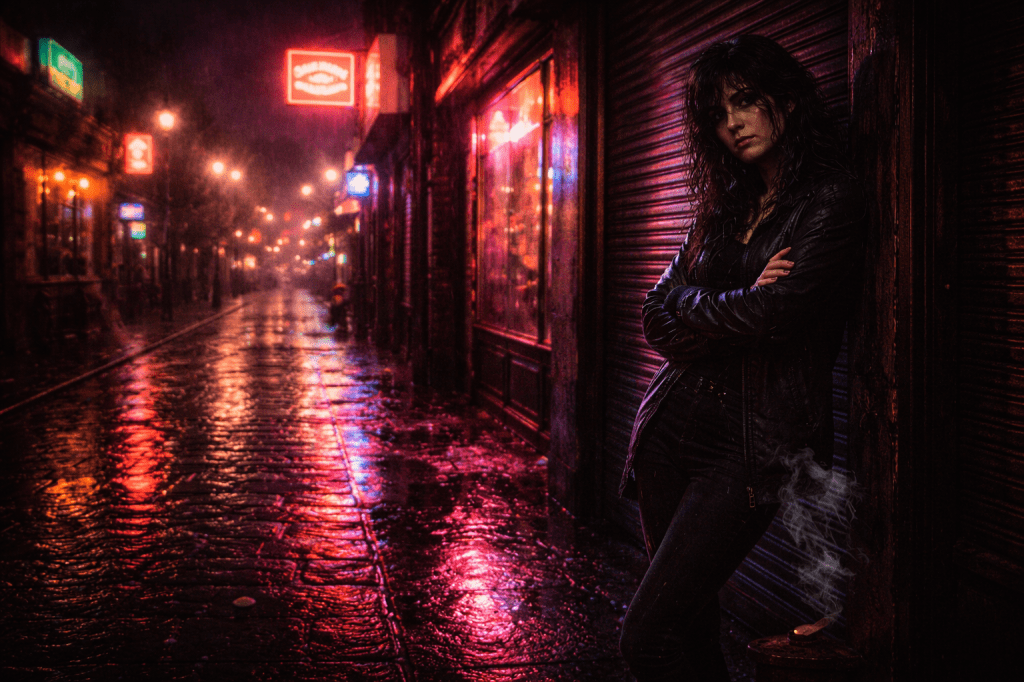
Salamander Street was hissing wet that night, a long slick ribbon of neon-pink puddles and cheap light that bled off the takeaway signs, and the whole place breathed that late-night lungsteam of chips and diesel and end-of-shift souls drifting homeward, and I’d walked too far, head full of Jamie’s crackling ghostvoice, lost-not-lost lad, and the Nocturne Man’s hush still clang to the back-corners of my thoughts like a childhood bruise refusing to fade, when I saw her—leaning against the shuttered doorway of some forgotten shop, arms crossed tight like she was holding the night itself closed around her, hair slick with rain, eyes flashing that sharp blue-white glint that looked exactly like Slateford’s shatterlight from years ago, aye, that same electric fracture that bursts in the ribcage before you can name it.
She looked at me the way foxes do, the way danger does, sideways and bright, and for a cracked second I thought I knew her—not from life but from some old half-dream some backlit mindspasm some flicker of déjà vu—and she tilted her head as if she heard that thought slide through me, as if she had the same ghostdial tuned to the same low-frequency I’d been carrying since Powderhall, and she smirked, a tiny lift of lip, like she’d caught me in a lie I hadn’t spoken yet.
“Ye walk like ye’re chasin’ somethin’ ye cannae catch,” she said, and her voice was warm and rough and edged with the kind of cigarette-night wisdom only the city teaches, and the way she said it cut through my chest, soft-blade and sure, because it was true—I’d been chasing my thirteen-year shadow, chasing Jamie’s tremor-shake silhouette, chasing the echo of broken glass that still rang in the head, chasing the Nocturne Man’s whisper through the fogfold corridors of memory, chasing some version of myself that kept slipping further down the street.
I told her I wasn’t chasing anything, and she laughed—a real laugh, a cracked-lantern laugh, a laugh with its own rainshimmer—and said, “Aye ye are, laddie. Even the street can see it.” And right then the puddles around us shimmered in that weird mindlight way, and the neon peeled itself into strange shapes that looked almost like words—aye lad hush, aye lad run, aye lad break and mend and break again— and she didn’t blink, didn’t flinch, just watched the reflections twist like it was everyday business for the night to speak in puddleglyphs.
She asked if I wanted a drink or a smoke or a story, and I chose the story because a part of me—some bravebroken shard from Slateford days—wanted to know what kind of tale a woman like that kept beneath her ribs, but she didn’t tell me anything about herself; instead she said, “Tell me what monster followed ye here.” And the way she asked it made the Nocturne Man stir, aye, that old shadow-stitch figure tightening under the bedboards of the mind, whispering nae-lad-nae, dinnae let her see, and Jamie’s voice too, distant and cracked—mind yersel lad, mind yersel—and I swallowed both murmurs like bitter salt.
“I don’t know,” I lied. She smiled like she’d seen the lie coming. “Aye ye do,” she said. “But it’s fine. We’re all walkin’ wi’ something behind us.” And then she flicked her cigarette into the street, and the ember hissed on the wet ground like a tiny drowned star, and for a breath the night seemed to lean in closer, the whole city cocking its head as if listening.
She stepped toward me, and the rain shone on her cheekbones, that Slateford-shard glimmer in her eyes, and in a whisper low enough to stir only the fog between us, she said: “Ye dinnae need to catch it, ye ken. Sometimes the chasin’ is the only thing keepin’ ye from goin’ under.”
Then she turned, quick as a shadow turning into itself, and walked away with that surefoot, half-wild gait that said she knew the streets better than they knew her, and I stood there like a fool in the neon rain, watching her dissolve into the darkmouth of the next close, taking something with her—some fever, some echo, some bit of the old fear-bloom or maybe the old hope-spark—leaving only the puddles murmuring their strange wee prophecies and my heart thundering its old Slateford rhythm against my ribs.
And as the street lights flickered—aye, that same staccato jitter the clocktower sky had shown me at Leith—I heard her voice fade back down the night in some soft, surreal residue, run if ye must lad, but mind where ye break on the way. And I didn’t chase her. Didn’t dare. Just stood there with the ghosts and the rain and the neon and felt the whole cycle tighten by one more loop.

 Hallway After Midnight