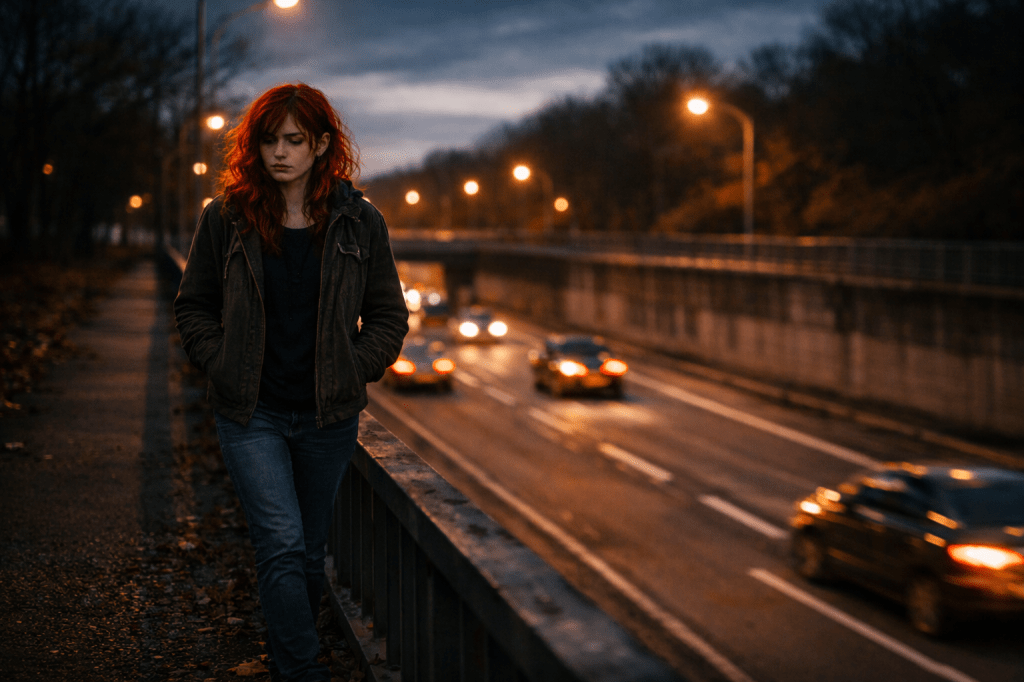
She stands where the city thins into lanes of speed and slipstream, where the bypass roars its long throat-song all night and the cars go ssaaahh–ssaaahh–ssaaahh in endless breath-lines, a river made of metal and hurry, and the wind keeps shouldering her coat with that sideways insistence that feels like instruction, like the road itself trying to teach her how to move without choosing, and the verge-grass shivers in the headlight-wash, pale blades writing temporary alphabets no one stays to read, and she watches the taillights peel away into red threadings of distance, stitch by stitch unravelling themselves from the dark, and something in her chest matches the motion, loosening, untying, the body learning the grammar of passing-through before the mind has named what it wants to leave behind.
And the air tastes of petrol and wet stone and that faint electrical tang that gathers near roads like a halo of spent intention, and the rain hangs in a low undecided mist, not quite falling, more a breath-cloud the world exhales and forgets, and the streetlamps along the sliproad wear their tired sodium auras like bruised saints, each one humming its own small hmmmm into the night, and she listens to the layered noise of it all—engine-surge, tyre-hiss, the soft pop-tick of cooling metal from a lorry pulled over too far to the left—and she feels how the sound presses on the inside of the skull, not loud enough to hurt, just constant enough to become the background rhythm of her thinking, the tempo her thoughts have learned to walk to.
And she is not yet inside Edinburgh, not yet in the fold of streets and windows and the soft-lit promise of being among others, but here on the margin where movement doesn’t require story and no one needs to know her name, and she feels the peculiar safety of being on the edge of somewhere rather than inside it, the way outskirts let you be unclaimed, unfiled, a body in transit without destination, and the road doesn’t look at her, doesn’t ask her what she wants, doesn’t mirror her back to herself, it simply moves, and the moving is its own permission.
And memory comes not as images but as pressure in the joints, a tightening in the shoulders that remembers how rooms once taught her to take up less space, how kitchens learned her smallness and bedrooms learned her quiet, how the choreography of staying unnoticed had written itself into her muscles long before she understood the dance, and she shifts her weight from one foot to the other, feeling the ground’s dull cold through the thin sole of her shoe, the earth reminding her she has weight, that she is here, that even at the margins the world insists on contact.
And the wind carries fragments of other lives past her face—radio-chatter from an open window, a burst of laughter clipped by speed, a word torn in half and flung into the hedgerow—and she catches these half-sounds like lost syllables, holding them briefly in the mind before they dissolve, and she wonders, not for the first time, how many lives brush against her without touching, how many stories pass through the same night without ever knowing they shared air.
And the bypass keeps its long sermon going, ssaaahh–ssaaahh–ssaaahh, and the night feels wider here, less intimate, a big cold space where the sky doesn’t lean in to listen, and she stands in it, small and particular, her breath fogging once and then again, little cloudlets of proof that she is still producing heat, still exchanging something with the dark, and the thought lands softly, without drama: that being here, at the edge of the city, at the edge of motion, feels like standing at the lip of a sentence before the verb arrives, the whole of movement coiled and waiting, the road already speaking the language of leaving, the city somewhere ahead holding its mouth open for her without yet saying her name.
 Hallway After Midnight