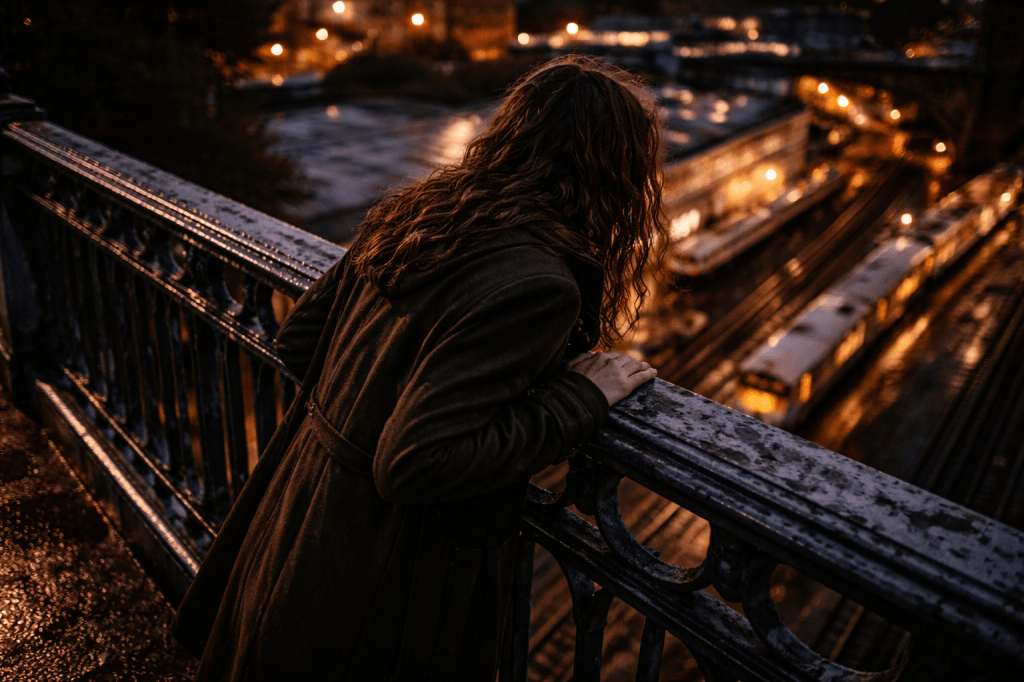
After a while she leans forward a little and looks through the narrow gaps of the iron railings and the city opens beneath her in a slow quiet collapse of distance, and what had been only darkness beyond the bars becomes shape and depth and structure as her eyes adjust, and the hollow of Waverley Station spreads below the bridge like a long bowl of dim amber lights and black rails and shadowed platforms, and the wind rises from it in slow cold breaths—upwind railwind—carrying the faint metallic scent of steel and oil and rain-soaked stone.
And the height announces itself gradually, no dizziness, no dramatic vertigo but just the quiet mathematics of distance, because the platforms below appear smaller than they should and the trains move through them with a strange deliberate patience, and the long parallel rails stretch outward in thin shining lines that bend away beneath the city like silver threads laid carefully along the floor of the valley, and somewhere down there a train begins to move with that deep mechanical murmur—steelwhirr lowrumble clank—and its lights glide slowly across the platform like a cautious animal stepping through a dimly lit clearing.
The sound travels upward in fragments, because the bridge does not silence the station but filters it, and the noises rise through the dark space between the iron supports and the stone arches in softened echoes—brakehiss echoecho a distant metallic knock the faint ghost of a voice carried upward and broken apart by the wind—and all of it gathers into a strange hollow music beneath the bridge, railhum lowhum citybelow breathing steadily in the night, and Mara’s hands rest on the railings without her quite remembering when she placed them there, her fingers curled loosely around the cold wet iron bars while the wind threads through the narrow gaps with a thin whispering note—hushhush railhush—and presses lightly against the fabric of her coat and lifts the damp strands of her hair, and the metal beneath her skin feels older than the street behind her, older than the lamps, older even than the trains moving slowly through the station below.
The longer she looks the more the space beneath the bridge seems to expand, because the human eye does not measure depth very well in darkness and the mind begins to exaggerate the distances between the points of light, and the rails become thinner and thinner until they resemble delicate luminous wires stretching into the far corners of the city, and the trains slide along them with a slow patient rhythm—steelwhirr glideglide rumble—entering the illuminated platforms and vanishing again beneath the roofs of the station like thoughts drifting briefly through a restless mind before dissolving into the next, and above all of it the bridge remains still, and the road behind her continues its quiet circulation of traffic with the soft roadhiss of tires on damp asphalt and the occasional muted clunk of suspension passing over uneven joints in the pavement, and somewhere further along the span a bus exhales briefly at a stop and then pulls away again with a tired mechanical sigh, and these sounds belong to the surface world of the city, the ordinary motion of people crossing from one side of Edinburgh to the other.
Yet in front of her there is only the open air, the narrow iron bars of the railing and then the long silent drop and the glowing mechanical basin of the station far below where trains arrive and depart and arrive again with the steady persistence of a heart that refuses to stop beating, and the wind continues its slow ascent through the bridge with that thin whispering sound—hushhush hushhush—while the lights of the platforms flicker faintly in the damp night and the dark rails stretch away through the valley of the city like quiet promises of movement toward places she cannot see.
 Hallway After Midnight