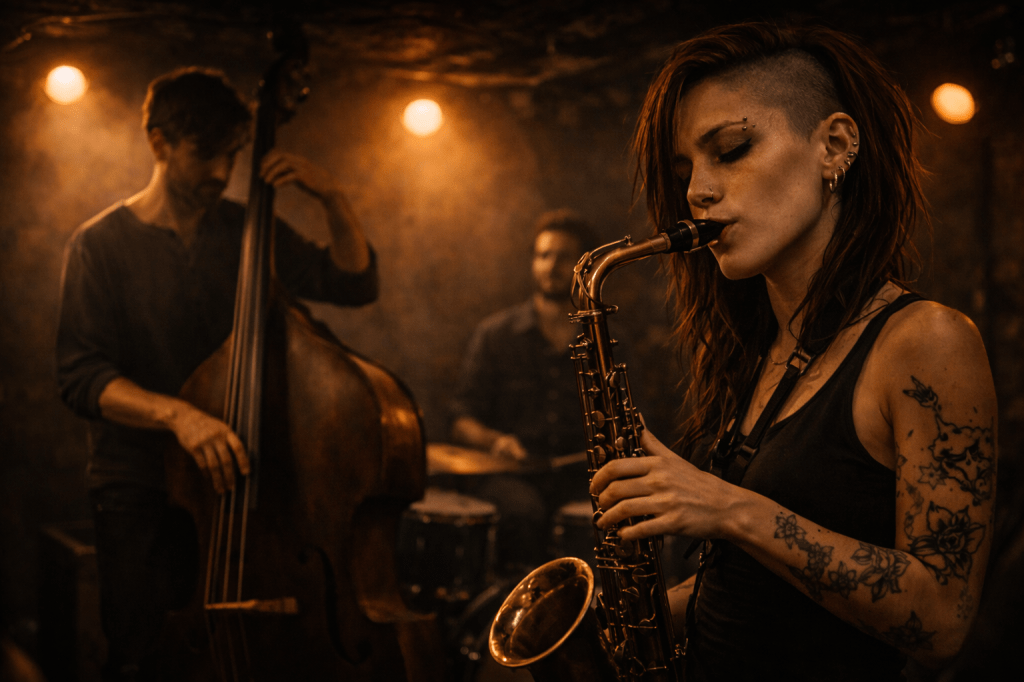
The night takes us down, not metaphor-down but stair-down, step-drop step-drop into the cellar’s belly, and the city folds itself overhead, street-noise thinning to a skin, and the room greets us with its low-ceiling breath, sweatwarm already, bodies packed shoulder-to-shoulder like clauses without punctuation, the air thick with beerghost and brass-memory, and somewhere behind the bar a glass breaks and nobody flinches because that’s part of the rhythm too.
Sorcha moves differently here, denser, posture tightening into intention, jacket shrugged off like an afterthought, horn case hugged close, and I follow half a beat behind, observer-role reactivated but altered, because this is not the flat and not walking and not the kiss-space, this is her elsewhere, her unsmoothed zone, and I feel the small flare of something sharp-edged spark awake in the ribs—call it jealousy if you want but it’s more like reverence mixed with fear, the fear of watching someone belong completely to a thing that isn’t you.
And the room settles, and the lights dim-not-dim, that cellar glow where everything looks amber-stung and forgiven, and she steps onto the low platform like it’s not a stage but a continuation of floor, nods once to the drummer, twice to the bass, and the count-in happens without counting, breath-in, eyes-up, and then the sound drops.
And Christ, the sound—rawreed ripcurl, spitbright lowcry, and the sax punches air into shape, bends notes until they plead and then snaps them clean, and the drummer rides brushwhirr shufflehiss, bass thudding its heartsteady anchor, and Sorcha leans into it, body folding round the horn, shaved scalp gleaming under the light like a blade-edge, piercings flashing syncopation, tattoos shifting with muscle and breath, and the room reorganises itself around her whether it meant to or not.
I’m pinned then by sound-pressure, the music hits sternum and gut and memory all at once, and stirs up half-buried nights and borrowed rooms and exits I never took because I hadn’t learned how yet, and I realise how wrong I’ve been about control, about containment, about who holds who, because she’s not pouring herself out here, she’s building something and standing inside it, letting the sound do the work of keeping, and people listen, actually listen, the way people do when they’re not pretending to be listeners, mouths half-open, drinks forgotten, bodies swaying without choreography, and I see her in the mirror behind the bar too, doubled and tripled, Sorcha-as-sound, Sorcha-as-motion, Sorcha-as-center-of-gravity, and it dawns on me with a slow bright ache that this is what it looks like when someone doesn’t ask permission to take up space.
And the set rolls on, and tune bleeds into tune, no clean edges, just momentum, and I feel myself shrink and expand at the same time, pride swelling, fear flaring, the old impulse to disappear testing the exits, and for once it doesn’t win, for once I don’t want to vanish from the room that made her more herself, and when the last note finally breaks, cracking into applause and whistles and table-thumps, the sound lingers like heat does after a body leaves a chair, and she steps down flushed and breathing hard, eyes bright, and finds me in the crowd without searching, like she knew exactly where I’d be standing.
And in that look—brief, unceremonial, shared—I understand something fundamental shifts here, that whatever this is between us will never be built on shelter alone, never on convenience or softness or mutual distraction, but on the fact that she has a center that isn’t me, and I am not invited to replace it, only to stand close enough not to lie about it.
Now the cellar exhales, night loosens its grip upstairs, and I follow her back into the noise and sweat and laughter, carrying the sound inside me like a warning and a promise braided together, knowing now that staying means staying awake to this, to her fullness, to the way the music will always come first—and choosing, quietly, not to leave anyway.

 Hallway After Midnight