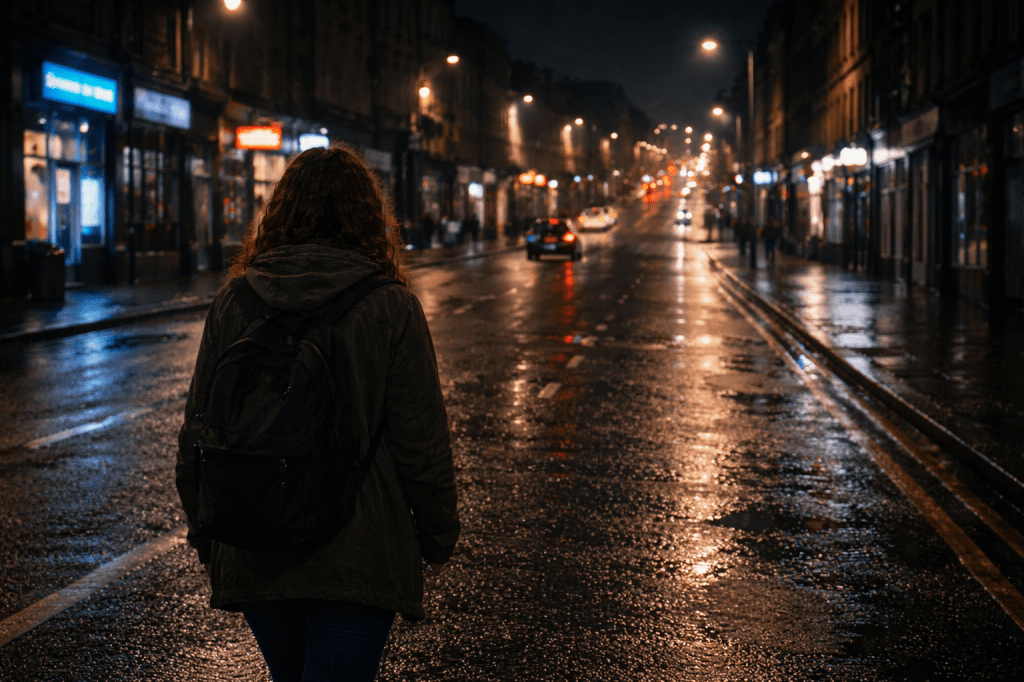
The rain has stopped but the city still remembers it, and Leith Walk lies stretched beneath the lamps in a long wet ribbon of asphalt and neon and reflected windows, and Mara walks uphill with her hands deep in the pockets of her coat and the collar pulled high against the wind that slips down from the Firth in thin restless breaths, and the pavement shines like dark glass under the streetlights and every passing car draws a quick white streak across the ground and then vanishes again into the slow breathing of the night, and she hears the soft hiss of tires on wet road and the distant hydraulic sigh of a bus opening and closing its doors and the faint murmur of voices somewhere behind her and the low electric buzz of a takeaway sign flickering blueblue above a closed shopfront, and her steps fall steady and unremarkable—step, step, step—and the sound joins the quiet rhythm of the street as if the asphalt itself were carrying her forward without asking why.
And people pass sometimes, one or two at a time and never staying long in her orbit—students laughing too loudly with the careless gravity of people still inside the evening, and a man talking into his phone in a language that rolls and clicks in soft quick syllables, and a couple moving close together under a shared umbrella and dissolving again into the dimness of the next block—and none of them look at her for more than a passing second because in a city like this a solitary figure walking uphill after midnight is nothing unusual and nothing worth remembering, and the anonymity settles over her like a second coat and feels almost like relief, and she watches the reflections instead of the street itself and sees the lamps stretch into thin golden lines across the wet pavement and the shop signs smear themselves into trembling blues and reds in the shallow puddles and the occasional pair of headlights bloom suddenly brightbright and then fade again, and the road beneath her feet seems almost fluid under the lights as if the whole street were moving slowly northward like a dark river carrying her with it.
And the city tilts gently upward and the buildings change almost without her noticing—brick becoming stone and windows narrowing and doorways sinking deeper into shadow—and she keeps walking because walking is simpler than stopping and stopping asks questions and walking asks nothing at all, and somewhere far below her the harbor lights blink faintly in the distance and somewhere ahead the ridge of the Old Town waits with its steep streets and older stones and the quiet gravity of centuries stacked one upon another, and the wind shifts slightly and brings the faint salt smell of the sea through the night air and she pauses for a moment at a crossing while the last few cars sweep past in soft rushing arcs of light and then she steps forward again and continues the slow climb, and behind her Leith Walk stretches downward in a long corridor of lamps and shuttered shops and empty bus stops and unasked stories, and ahead of her the city holds its darker center where the streets narrow and the buildings lean inward and somewhere beyond them—though she does not yet look for it directly—the open space of a bridge waits over black water and iron rails and the quiet height where a person can stand and feel the whole weight of the night pressing gently against the bones of the city.
 Hallway After Midnight