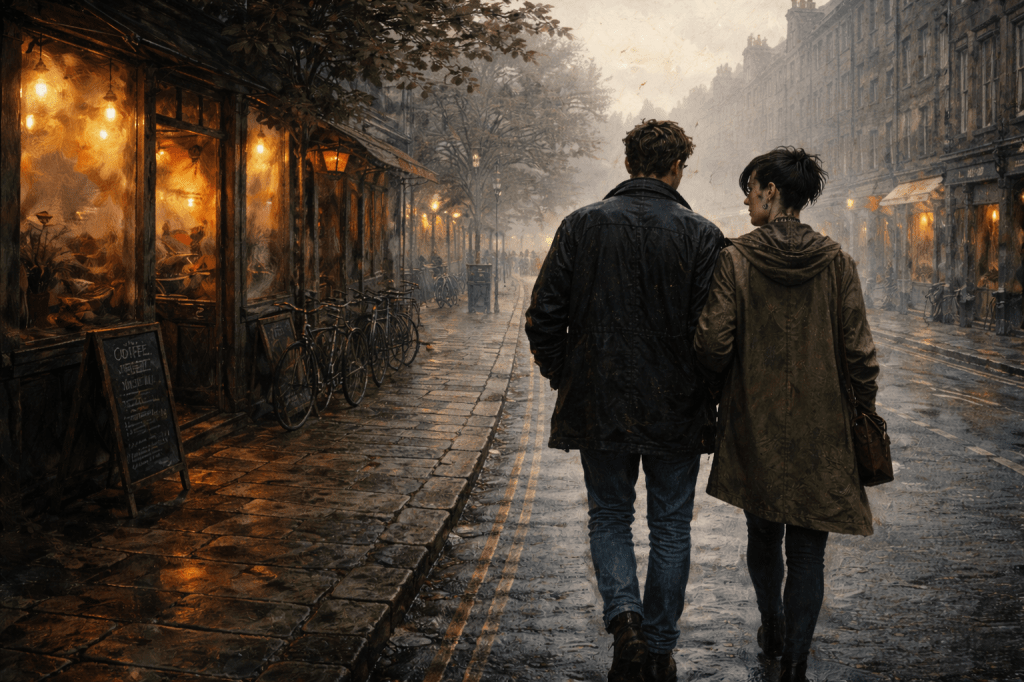
And out we go, doorclick-soft behind us, and the flat seals itself with that neat Morningside finality—no slam, no drama, just a tidy little hush like a librarian clearing her throat—and the street air slides straight in, clean and sharp and already disappointed in me, and the lungs wake up with a small shocked intake, ahh, that first cold bite that says enough-now, night’s over, behave yourself, and my head lags a beat behind, thum-thum hollowdrum, whiskey-hum still tunnelling through the bone, and the body follows Sorcha because bodies are good at following before minds start asking questions.
The pavement’s wide here, forgiving-wide, no slick sermonstones like Dalry, no echo-throated corridors like Broughton, just this steady, respectable stretch of grey where the feet can find a rhythm again—stepandbreatheandstep—and the trees stand along the street like they’ve signed an agreement with time to age slowly and without fuss, leaves holding on longer than expected, branches barely moving, and the whole neighbourhood wears its calm like a pressed coat it never takes off, even at night.
And Sorcha walks with that middle-tempo certainty, neither rushing nor drifting, just going, and I fall into the space beside her and feel the city recalibrate around us, adjusting its internal meter from stumble-jazz to morning-time, brushes on the snare instead of sticks, swish-swish, and the shops are waking up in half-gestures—shutters rasping up with a tired rrssh, bakery windows fogged with warmth pressing politely against glass, bookshop spines already aligned as if disorder were a moral failing—while people pass with dogs and prams and faces that have already forgiven themselves for yesterday, no gawking, no questions, just that Morningside noticing, the kind that weighs you without making a show of it.
And she points things out sideways as we go, lets the information drift into the air—this café’s decent, that corner catches wind, that chemist stays open late—and I understand without it being said that this is how you’re meant to move here, you don’t linger, you don’t spill yourself, you don’t turn the street into a stage, and the city nods along, yesyes, that’s right, behave and we’ll behave back.
We stop at a crossing, and the red man glows patient and monkish, and in the pause there’s that brief alignment of bodies syncing without comment, arm-close-to-arm, heat-through-wool, breath puffing once then gone, and for a second the world holds still just long enough to tempt me into meaning, into thinking this is a sign, a hinge, something worth naming, but the street refuses the shrine, and lets the moment pass unmarked, and I feel that old habit stir—the urge to crown coincidence as revelation—before the light flips and we’re moving again.
The squares appear, little boxed greens behind iron ribs, benches already occupied by readers and early smokers, a heritage folded down to human scale, a memory managed and fenced and politely captioned, and Sorcha gestures toward it, frames it without fanfare, as an example of how places decide what version of themselves survives, what gets polished and kept and what gets quietly paved over, and I hear the sharpened edge under the academic calm, the blade hidden in the language, and it scrapes against my own way of trusting stones more than stories, of wanting the city talk because people lie faster.
And my reflection rises up at me from a shop window and slips away again, and, strangely, the light here does that trick of making faces provisional, of softening damage without erasing it, and I look older in this glass, or maybe just less armoured, like the neighbourhood’s already sorted me into a category it doesn’t need to explain.
Here, coffee happens because it’s time, not because it’s earned, it’s fuel not ritual, and we stand at the counter in a café that might have opinions about milk and none about souls, shoulders almost touching, and I feel the strange relief of not performing, of not being the loudest thing in the room, and Sorcha scans the space the way some people read ruins, alert to absences as much as presences, trained to see what’s been arranged to look natural, and I imagine her in archives and lecture halls and broken sites arguing gently but relentlessly about who gets remembered cleanly and who gets left rough, and for a moment I feel myself slipping into that argument, an inconvenient footnote with legs.
Back outside the light thins further, gold threatens at the edges, and the day clears its throat and prepares to commit, and Morningside accepts this without fuss, without absolution, without promise, just continuation, and we walk on, stepandbreatheandstep, and it settles in, slow and certain, that this isn’t about falling anymore, it’s about balance, about learning the small choreography of a place that detoxes the night without pretending it never happened, a village that remembers without romance.
And I keep walking beside her, letting the sentence run and run forever, letting the street teach me how to stay upright without disappearing, still half-alive, still adjusting, and the morning keeps time—swish, swish, thum—while the night drains out of me one careful step at a time.

 Hallway After Midnight